Best Folding Room Divider When Floor Space Is Tight

Seven folding screens compared on the two figures that actually matter in an open living room: how wide the panels span and how heavy the thing is to move.

By Jadiel FranklinUpdated 18 min read
On this page
- Best folding room divider for living rooms at a glance
- How I screened these folding room dividers
- Width or height: which figure decides it?
- How much divider does a living room actually need?
- 1. FDW 4-Panel Folding Room Divider — Best overall
- 2. Grezone Room Divider-Folding Privacy Screens — Best for beginners
- 3. SUNALLY Room Divider Privacy Screens — Best for heavy use
- 4. Furnnylane 6 Panel Bamboo Room Divider — Best premium
- 5. JOSTYLE Rattan Room Divider — Best for families
- 6. SUNALLY Room Divider Privacy Screens — Best budget pick
- 7. FDW | 4-Panel Folding Room Divider — Best compact
- What the listings leave out
- When a different pick wins
- The verdict
- FAQ
The best folding room divider for living rooms is the FDW 4-Panel Folding Room Divider, because at 11 lb it's the lightest screen here that still stands 70 inches tall. If you need to wall off a much wider span, the Grezone Room Divider-Folding Privacy Screens opens to 200 inches and takes over. Everything else in this set of seven sits between those two extremes, and the gap is enormous. One screen covers 70.9 inches. Another covers nearly three times that.
Best folding room divider for living rooms at a glance
| Pick | Coverage width | Weight | Price |
|---|---|---|---|
Best overall FDW 4-Panel Folding Room Divider |
17 in listed | 11 lb | Check Price |
Best for beginners Grezone Room Divider-Folding Privacy Screens |
200 in | 20.9 lb | Check Price |
Best for heavy use SUNALLY Room Divider Privacy Screens |
88 in | 16.6 lb | Check Price |
Best premium Furnnylane 6 Panel Bamboo Room Divider |
92.1 in | under 21 lb claim | Check Price |
Best for families JOSTYLE Rattan Room Divider |
79.9 in | 13.2 lb | Check Price |
Best budget pick SUNALLY Room Divider Privacy Screens |
88 in | under 17 lb class | Check Price |
Best compact FDW | 4-Panel Folding Room Divider |
70.9 in | under 10 lb claim | Check Price |


How I screened these folding room dividers
I started with the published specifications and lined them up side by side. Height, coverage width, weight, panel count, material. Nothing else. That's a deliberately narrow filter, and it cut a lot.
Screens with no dimension figure at all went first. If a listing won't say how wide the thing opens, you can't plan a living room around it. Next out were the desktop and tabletop partitions that share the same category shelf but stand barely three feet high. Those don't divide a room, they decorate a desk.
What survived is seven freestanding folding screens, all between 66.9 and 72 inches tall. That range matters more than it looks. Six of the seven land within two inches of six feet, which is roughly eye level for a standing adult, so they block sightlines rather than just suggesting a boundary.
Here's the ranking logic, in order:
- Coverage width per unit of weight. A screen you can't move is a wall you didn't ask for.
- Stated construction. Steel frame, pinewood frame, or woven fibre.
- Setup burden. Zero-assembly beats screwdriver-required.
- Position in this set on price against what it actually delivers.
Three brands appear more than once: FDW twice and SUNALLY twice. I kept both pairs because within each pair the specifications diverge sharply. The two FDW screens differ by roughly 4 feet of coverage. The two SUNALLY screens differ by whether they roll.
Width or height: which figure decides it?
Most guides to the best folding room divider for living rooms lead with height. Six feet, six feet, six feet. It's the number in every product title, and it's very nearly useless as a comparison point, because almost every screen in this category is the same height.
Look at the range across these seven. The shortest is 66.9 inches. The tallest is 72 inches. That's a spread of 5.1 inches across the entire set, less than the difference between two throw pillows.
Now look at coverage width. The JOSTYLE opens to 79.9 inches. The Grezone opens to 200 inches. The compact FDW covers 70.9 inches. That's a spread of 129 inches, more than ten feet. Width is the specification that changes what the screen can do; height is the specification that stays the same.
Coverage width is the measurement of how much sightline the screen blocks when fully extended. In a living room, that number has to beat the gap you're closing. A sofa back is roughly 80 inches. A standard doorway opening is 32 to 36 inches. A dining zone carved out of an open-plan space is often 8 to 10 feet across.
Match the width to the gap and you get privacy. Undershoot it and you get a decorative object with a hole beside it. That's the failure mode, and it's the one nobody warns you about.
How much divider does a living room actually need?
Amazon's search only partially honours the living-room qualifier, so I can't tell you any of these seven screens was designed specifically for a living room. The listings mention living rooms among many other spaces: offices, dorms, classrooms, garages. Treat "living room ready" as something you judge from the dimensions rather than something the box promises.
What you can judge is fit. Measure the gap first, in inches, at the height of the tallest thing near it.
- A single armchair nook or reading corner: 70 to 80 inches of coverage handles it. The compact FDW at 70.9 inches and the JOSTYLE at 79.9 inches both land here.
- Behind a full-length sofa: 88 to 92 inches. Both SUNALLY screens and the Furnnylane bamboo sit in this bracket.
- Splitting an open-plan living and dining area: you want well past 100 inches, which in this set means the Grezone at 200 inches, or two smaller screens set end to end.
One more thing about living rooms specifically. This is the room where people sit down, so the screen gets looked at from a seated position for hours at a stretch. That pushes material further up the priority list than it would be in a home office. Woven rattan and natural bamboo read as furniture. Black polyester over steel reads as equipment.
1. FDW 4-Panel Folding Room Divider — Best overall
At 11 lb this is the lightest full-height screen here with a published weight, which makes it the one you'll actually bother to move.
Best for: renters who reposition the screen weekly Skip it if: you need to block a wide sightline
Weight is the specification that decides whether a folding screen gets used or gets stored. At 11 lb, this FDW is the lightest published figure in the set, and it stands 70 inches tall, so you're not trading height for portability. The panel dimension is listed at 17 inches, which puts a four-panel span in the same range as the compact FDW below.
The finish is Coal Black, a dark neutral that disappears against most walls. FDW's listing describes hand-woven construction and environmentally friendly wood, and calls the height "designed according to the height of most people." That's the manufacturer talking, not a measured claim, but the 70-inch figure in the specifications backs the general point.
It sells noticeably faster than the rest of this group, and it's the one buyers choose most often here by a wide margin. Two sellers list it.
The trade-off is coverage. This is a premium price position and it doesn't buy you extra width. The Grezone and both SUNALLY screens cover far more span for less outlay. You're paying for lightness, not for reach.
Pros:
- Lightest published weight in the set at 11 lb
- Full 70-inch height, no compromise for portability
- Sells faster than every other pick here
- Dark Coal Black finish blends into most walls
- Two sellers stock it
Cons:
- Premium price position for the narrowest listed panel width
- Coverage span well below the Grezone and SUNALLY screens
- Listing text contradicts itself on panel count
- No stated warranty period
2. Grezone Room Divider-Folding Privacy Screens — Best for beginners
The 200-inch coverage width is more than double anything else here, so it's the only pick that walls off a genuinely open span.

Best for: walling off a large open span Skip it if: you plan to fold and move it often
Nothing else in this set comes close on reach. The listed dimensions are 200 inches wide by 71 inches high, which is over 16 feet of continuous barrier. The next widest is the Furnnylane at 92.1 inches. If your problem is an open-plan living room that needs a real division rather than a suggestion of one, this is the answer and the others aren't.
It's also the second-cheapest of the seven, which is unusual for the widest product in a set. Grezone's listing says assembly needs only a Philips screwdriver and can be done solo. The count field lists 6, so expect a multi-piece delivery rather than one folded unit.
At 20.9 lb it's the heaviest published weight here, nearly double the FDW winner. That's the cost of the span.
The catch is manoeuvrability. A 16-foot screen weighing 20.9 lb is not something you shift while vacuuming. It's furniture you place once. Only one seller lists it, so your options are limited if it's out of stock.
Pros:
- 200-inch coverage, more than double the next widest
- Second-cheapest pick in this set
- Assembly needs only a Philips screwdriver, per Grezone
- Freestanding, works on any floor per the listing
Cons:
- Heaviest published weight here at 20.9 lb
- Requires assembly, unlike the zero-setup picks
- Too large to reposition casually
- Only one seller lists it
3. SUNALLY Room Divider Privacy Screens — Best for heavy use
Lockable wheels make this the only pick in the set you can move without lifting, which changes how often you'll actually use it.

Best for: daily repositioning on hard floors Skip it if: you dislike visible caster wheels
Every other screen here has to be picked up and carried. This one rolls. SUNALLY describes silent PE wheels that lock in place and won't scratch floors, which is the single most practical difference in this whole group if you rearrange a living room often. At 16.6 lb it's mid-weight, but the weight barely matters when the thing has casters.
Coverage is 88 inches across at 72 inches tall, making it the tallest pick here. That 88-inch span sits behind a full-length sofa cleanly. The fabric is described as 240gsm polyester with a PA coating for a non-see-through panel, and the frame as powder-coated steel with a thickened base. Plastic double hinges let you set any angle.
Three sellers list it, the most in this set.
Two honest problems. The wheels are visible, and in a room where the screen is a design element that reads as office equipment rather than furniture. SUNALLY's own listing also warns that fabric may arrive with stains that fade in ventilation, which is a strange thing to publish and worth knowing before you order.
Pros:
- Only pick here with lockable wheels
- Tallest in the set at 72 inches
- 88-inch coverage suits a full sofa span
- Powder-coated steel frame per SUNALLY
- Three sellers stock it
Cons:
- Visible casters look utilitarian in a living room
- Listing itself warns of possible fabric stains on arrival
- Polyester panels read as office partition, not furniture
- No stated warranty period
4. Furnnylane 6 Panel Bamboo Room Divider — Best premium
Six panels of natural bamboo covering 92.1 inches, and the only pick here that looks like furniture rather than a partition.

Best for: warm natural materials in a visible room Skip it if: you want a dark screen that disappears
This is the only six-panel screen in the set, and panel count matters more than it sounds. Each panel measures 15.35 inches wide, so you get six hinge points instead of four. That means you can zigzag it around a corner, curve it into a C-shape, or stand it in a tight S that self-supports. A four-panel screen can't do that.
Full width is 92.1 inches at 66.9 inches tall, the shortest height here by about three inches. Furnnylane says no assembly is needed, just unfold. Construction is natural bamboo on a hand-sanded solid pinewood frame with reinforced metal hinges and non-slip base pads, and the listing states no chemical paints or synthetic glues. Claimed weight is under 21 lb.
The natural brown finish is what you buy this for. In a living room that anyone looks at, bamboo beats black polyester.
It's the most expensive pick here and it publishes no exact weight figure, only Furnnylane's "under 21 lbs" claim. It's also the shortest, which costs you a little sightline coverage.
Pros:
- Only six-panel screen here, folds around corners
- Natural bamboo and pinewood, no synthetic glues per Furnnylane
- 92.1-inch coverage, second widest in the set
- Zero assembly, unfolds ready to stand
- Non-slip base pads for hardwood, tile or carpet
Cons:
- Most expensive pick in this set
- Shortest height at 66.9 inches
- No exact weight published, only a manufacturer claim
- Light brown finish shows dust more than dark panels
5. JOSTYLE Rattan Room Divider — Best for families
At 13.2 lb with 79.9 inches of coverage, this is the best width-to-weight ratio of any pick with a published weight.

Best for: softening a corner with woven texture Skip it if: you need an opaque fabric barrier
Run the numbers. The JOSTYLE covers 79.9 inches and weighs 13.2 lb. The Grezone covers more but weighs 20.9 lb. The FDW winner is lighter but narrower. For a household that shifts furniture around children, pets and visitors, this ratio is the sweet spot, and it's why this one earns the family label.
Height is 70.9 inches and the colour is a gray-green rattan weave. JOSTYLE claims zero assembly, unfold and done, with no tools, and describes the screen as 10% wider than average and under 14 lb. Triple-reinforced joints are claimed for daily use. The count field lists 4, matching the four panels.
It's the third-cheapest here, which for this width-to-weight combination is the value story of the set.
Two real drawbacks. Woven rattan is not a solid barrier, so light and some visibility pass through the weave in a way that the coated polyester screens block outright. And it's the slowest-selling pick of the group apart from the compact FDW, with a single seller listing it.
Pros:
- Best published width-to-weight ratio in the set
- 79.9-inch coverage at just 13.2 lb
- Zero assembly, no tools per JOSTYLE
- Gray-green rattan suits modern or farmhouse rooms
- Third-cheapest of the seven
Cons:
- Woven panels let light and some visibility through
- Only one seller lists it
- Sells slower than most picks here
- No stated warranty period
6. SUNALLY Room Divider Privacy Screens — Best budget pick
The cheapest of the seven, and it still delivers 88 inches of coverage at 71.3 inches tall.
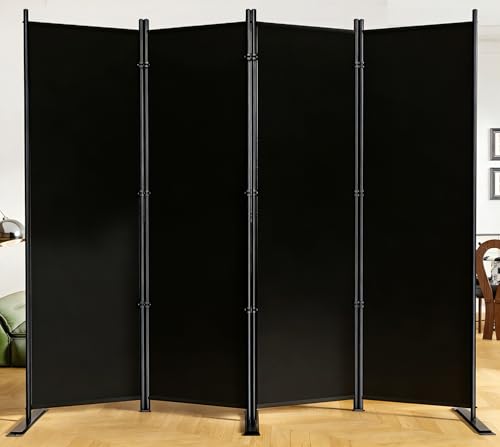
Best for: coverage on the smallest outlay here Skip it if: you want zero-assembly setup
This is the wheel-free sibling of the pick at number three, and the specifications are close: 88 inches wide, 71.3 inches tall, four panels, black. What you lose is the casters. What you gain is the lowest price position in the whole set, which makes it the best coverage-per-outlay pick by a distance.
SUNALLY describes a reinforced steel frame with a powder-coated, scratch and rust resistant finish, and high-density polyester with a PA coating that blocks visibility. Flexible multi-buckle hinges let you set any panel angle, which matters if you're wrapping the screen around a sofa corner rather than running it straight.
Two sellers list it. Assembly is required, with hardware and instructions included per the listing.
The honest weaknesses are real. No weight is published at all, so you're planning around an unknown, and given the steel frame it's probably not the lightest here. It's also the slowest seller of the six main-line picks. Black coated polyester is functional, not decorative.
Pros:
- Cheapest pick in this set
- 88-inch coverage at 71.3 inches tall
- Powder-coated steel frame per SUNALLY
- Multi-buckle hinges adjust to any angle
- Hardware and instructions included
Cons:
- No published weight figure at all
- Requires assembly, unlike the bamboo and rattan picks
- No wheels, unlike its own stablemate
- Slowest seller of the main picks here
7. FDW | 4-Panel Folding Room Divider — Best compact
The narrowest screen here at 70.9 inches, and the only pick with a stated guarantee period.

Best for: a single reading nook or corner Skip it if: you need to span more than six feet
Coverage here is 70.9 inches wide by 70.7 inches tall, almost a perfect square when open. That's the smallest footprint in the set, and for a single armchair, a corner desk, or a pet crate you'd rather not look at, small is the point. FDW lists each panel at 70.8 by 17.72 inches and each screen at 0.79 inches thick.
Two details separate it from everything else. First, FDW claims folded thickness of just 8 cm, which means it stores flat behind a sofa or inside a closet. Second, FDW states a three-month after-sales quality guarantee. That's the only stated guarantee period across all seven picks, and in a category where nobody publishes warranties, it counts.
The panels are hand-woven plant fibre in brown, described as specially treated and pollution-free.
It sells far slower than any other pick here, by a wide margin. It also sits in a premium price position while covering the least width in the set, which is a hard combination to justify unless the compact size is exactly what you need.
Pros:
- Only pick with a stated guarantee period, three months
- Folds to a claimed 8 cm thickness for flat storage
- Claimed weight under 10 pounds, lightest figure quoted here
- Hand-woven plant fibre panels in warm brown
- Smallest open footprint, 70.9 inches wide
Cons:
- Narrowest coverage of all seven picks
- Premium price position for the least width
- Sells far slower than every other pick here
- Only one seller lists it, and no exact weight is published
What the listings leave out
Three gaps run across all seven of these listings, and knowing them saves you a return.
Folded footprint. Only the compact FDW publishes a folded thickness, at a claimed 8 cm. Everyone else tells you the open width and stops. If storage is the reason you want a folding screen rather than a fixed partition, that omission matters, because a six-panel bamboo screen folds into a very different package than a four-panel steel one.
Stability on soft flooring. Furnnylane is the only brand that names the surfaces its base pads handle: hardwood, tile and carpet. Freestanding screens rely on the hinge angle for balance, so a straight-line setup on thick carpet is less stable than a zigzag on tile. Angle the end panels inward whatever you buy.
Panel opacity. SUNALLY publishes a fabric weight of 240gsm with a PA coating on one of its screens, and calls both non-see-through. The rattan and bamboo picks make no opacity claim at all, because woven material can't make one. If you want a screen that blocks light as well as sightlines, the coated fabric picks are the honest choice.
Weight, on three of seven. The Furnnylane, the compact FDW and the budget SUNALLY publish no exact weight in the specifications, only claims or nothing. Two of them are the picks you'd most want to carry.
When a different pick wins
The FDW winner is the right default, but three specific conditions flip it. Check yourself against these before ordering.
- If your gap is wider than 92 inches, the winner can't reach it and neither can four of the others. The Grezone Room Divider-Folding Privacy Screens at 200 inches is the only single-unit answer in this set.
- If you'll move the screen more than once a week, wheels beat light weight. The SUNALLY with lockable casters rolls where an 11 lb screen still has to be lifted and carried.
- If the screen sits in a sightline from your sofa, material outranks specifications. The Furnnylane bamboo and the JOSTYLE rattan read as decor. The black polyester picks read as equipment.
Two smaller flips are worth naming. If you need the screen to block light rather than just sightlines, choose one of the coated polyester picks over any woven panel, because a weave passes light by design. And if you refuse to assemble furniture, three picks are zero-setup by their own listings: the Furnnylane, the JOSTYLE, and the compact FDW. Both the Grezone and the budget SUNALLY need a screwdriver.
The verdict
The FDW 4-Panel Folding Room Divider is the best folding room divider for living rooms because 11 lb is the figure that determines whether a folding screen keeps getting folded. It stands 70 inches tall, which puts it at eye level, and it's the one buyers here choose most often by a considerable margin. In a living room, where the layout shifts for guests, for a Christmas tree, for a rearranged sofa, a screen you can lift one-handed is worth more than one that covers eight extra inches.
Two conditions flip that. If the gap you're closing runs wider than 92 inches, the Grezone Room Divider-Folding Privacy Screens is the only pick in this set that reaches, at 200 inches for the second-lowest price here. That's its exact advantage over the winner: reach, at roughly double the weight.
The second condition is aesthetic. If the screen will sit in view from where you sit, the Furnnylane 6 Panel Bamboo Room Divider is the better buy. Six panels at 15.35 inches each let it curve around a corner, and natural bamboo on pinewood looks like furniture in a way that coated black polyester never will. You pay the most in this set for that, and you accept the shortest height at 66.9 inches.
Everything else here is a variation on those three answers.
FAQ
Is a folding room divider worth it in a living room?
A folding room divider is worth it in a living room when you need a boundary that comes and goes. Unlike a fixed partition, these fold flat and store, and six of the seven picks here stand within two inches of six feet, so they block sightlines at standing height. If the boundary is permanent, build a wall instead.
How wide should a folding room divider be?
How wide a folding room divider should be depends on the gap, measured in inches before you order. A reading nook needs 70 to 80 inches, so the compact FDW at 70.9 inches fits. A full sofa span wants 88 to 92 inches. An open-plan living and dining split needs well past 100 inches, which here means the Grezone at 200 inches.
Which offers better value, the FDW or the SUNALLY budget screen?
Better value between the FDW and the SUNALLY budget screen comes down to what you prioritise. The SUNALLY is the cheapest pick here and delivers 88 inches of coverage at 71.3 inches tall, so it wins on coverage per dollar. The FDW costs more and covers less, but at 11 lb it's the lightest published weight and needs no assembly hardware.
Do folding room dividers block light as well as sightlines?
Folding room dividers block light only if the panels are solid. SUNALLY specifies 240gsm polyester with a PA coating and calls both of its screens non-see-through. The JOSTYLE rattan and Furnnylane bamboo picks make no opacity claim, because a woven surface passes light through the weave. Choose coated fabric if darkness matters as much as privacy.
What is the most common mistake buying a folding room divider?
The most common mistake buying a folding room divider is comparing height instead of width. Across these seven picks, height spans just 5.1 inches, from 66.9 to 72 inches. Coverage width spans 129 inches, from 70.9 to 200. Width decides whether the screen closes your gap. Height barely varies, so it can't be the deciding figure.
Measure the gap you want to close, in inches, then match it to the coverage figures in the table above. That single step eliminates most of this set for you and leaves two or three genuine candidates. For most living rooms, the FDW 4-Panel Folding Room Divider is the right starting point, not because it does the most, but because at 11 lb it's the screen you'll still be repositioning next spring rather than leaving folded behind the couch. A divider that never moves is just a wall you paid to store.