Best Hanging Room Divider for Open-Plan Rooms

Five hanging room dividers compared by panel count, material and reach. The KEIBIKEIDI set wins on tile count and modular length, but wood and felt options flip the pick for warmth and sound.

By Jadiel FranklinUpdated 13 min read
On this page
- Best hanging room divider for living rooms at a glance
- How I screened these five hanging dividers
- 1. KEIBIKEIDI Hanging Room Divider — Best overall
- 2. Stepstall PVC Hanging Room Divider — Best budget pick
- 3. WoodTuct Wooden Hanging Room Divider Panels — Best premium
- 4. OSHIYINN 3D Flower Venus Panel — Best compact
- 5. Lchen Wood-Plastic Hanging Panels — Best for families
- Does a hanging divider actually work in a living room?
- PVC, wood or felt: which panel suits your wall?
- How much coverage do you actually get?
- When a different divider wins
- The verdict
- FAQ
The best hanging room divider for living rooms is the KEIBIKEIDI 16-panel PVC set, because 16 tiles at 15.7 x 15.7 in give you the most surface to work with and you cut the drop to fit. The WoodTuct walnut-tone set is the better buy if you can drill the ceiling and want a warm wood look. Here's the honest truth on this whole category: none of these five was built specifically for a living room, so what matters is coverage and how you mount it. Entry PVC sets like the KEIBIKEIDI and Stepstall give you plenty of panel for little money. The premium wood and felt picks buy you texture, not size. Match the tier to what your space needs, not the price.
Best hanging room divider for living rooms at a glance
| Pick | Material | Coverage | Price |
|---|---|---|---|
Best overall KEIBIKEIDI Hanging Room Divider |
PVC | 16 panels 15.7 x 15.7 in each |
Check Price |
Best budget pick Stepstall PVC Hanging Room Divider |
PVC | 12 panels 11.8 in each (claim) |
Check Price |
Best premium WoodTuct Wooden Hanging Panels |
4mm birch plywood | 12 panels 11.4 x 11.4 in each |
Check Price |
Best compact OSHIYINN 3D Flower Venus Panel |
Polyester felt fiber | 1 panel 12 x 14 in |
Check Price |
Best for families Lchen Wood-Plastic Hanging Panels |
Wood-plastic | 10 panels 11.4 x 11.4 in each |
Check Price |


How I screened these five hanging dividers
I compared the published specifications side by side and ranked on the two things a living-room buyer can actually check before ordering: how much panel you get, and what the panels are made of. Everything else is styling.
Here is what I looked at, in order of weight:
- Panel count and per-tile size. More tiles across more square inches means a wider gap covered.
- Material. PVC, plywood and felt hang and read very differently across a room.
- Weight. A heavier set needs a sturdier anchor point overhead.
- How it mounts. Ring-linked panels behave differently from a set that drills into the ceiling.
Two facts cut the field fast. The OSHIYINN listing shows a count of 1, so a single 12 x 14 in panel is a spot cover, not a wall. The WoodTuct set says outright that installation requires drilling the ceiling, which rules it out for many renters. Neither is disqualified. Both just serve a narrower buyer, and I ranked them where that buyer sits.
1. KEIBIKEIDI Hanging Room Divider — Best overall
The KEIBIKEIDI set wins the best hanging room divider for living rooms slot on sheer coverage: 16 panels at 15.7 x 15.7 in each is more surface than anything else here.
Best for: renters who want to cover a wide gap and cut panels to fit Skip it if: you want a warm, solid-looking wood surface
Coverage is the whole reason this one leads. Sixteen tiles at 15.7 x 15.7 in beat the 12-panel and 10-panel sets on both count and per-tile size, so you span more of a living-room opening before you run out of panels. The whole set weighs 2.4 lb, light enough to hang from a curtain track or a tension rod rather than a ceiling anchor.
KEIBIKEIDI says the panels use eco-friendly PVC with "no painting, no glue," and that the box includes connect rings. The brand also says you can DIY the shape and length, cutting tiles down to fit a specific drop. That modularity is the practical edge over the wood picks, which arrive at a fixed panel size. It's the second-cheapest of the five and several sellers list it. The trade-off is honest: PVC in white reads as decorative, not solid, so it screens a sightline rather than blocks a room. If you want the weight and grain of real wood, this is not that.
Pros:
- Most panels here at 16
- Largest per-tile size, 15.7 x 15.7 in
- Light 2.4 lb set, easy to hang
- Connect rings included per the listing
- Panels can be cut to length
Cons:
- PVC looks decorative, not solid
- White pattern offers limited privacy
- No stated warranty
2. Stepstall PVC Hanging Room Divider — Best budget pick
The Stepstall set is the cheapest of the five and the easy way to test the hanging-divider look before you commit real money.

Best for: a first-time buyer testing whether the look suits the room Skip it if: you need light, airy white panels
This is the lowest price position in the group, so it's the low-risk entry point. You get 12 panels in classic black. Stepstall lists each piece at 11.8 in per side, smaller than the KEIBIKEIDI tiles, which means you'll need more of them or a narrower gap to fill.
Black is the interesting choice here. Against a bright living-room wall, a dark panel reads as a firmer visual break than white, so this set gives more apparent privacy for the money. Stepstall says the material is eco-friendly PVC with no painting or glue, the same construction story as the overall winner. The brand also notes you can stick the panels as wall decals or add weight to the bottom for outdoor use, which widens what a single box does.
The catches: only one seller lists it, and the smaller panel size means less reach per piece than the winner. There's no published warranty either. As a first divider to see whether the effect suits your room, though, it's the sensible spend.
Pros:
- Cheapest pick in this set
- 12 panels for the price
- Black reads as firmer visual screen
- Doubles as wall decals per the listing
Cons:
- Only one seller lists it
- Smaller 11.8 in tiles than the winner
- No stated warranty
- Fewer panels than the KEIBIKEIDI set
3. WoodTuct Wooden Hanging Room Divider Panels — Best premium
The WoodTuct set is the one to buy when you want a real wood look and can drill into the ceiling to hang it properly.
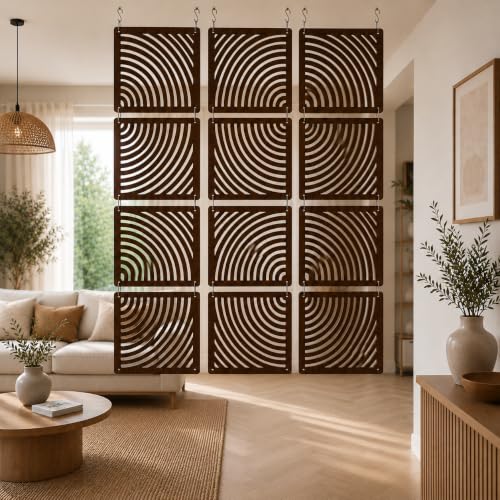
Best for: owners who can drill the ceiling and want a walnut-tone finish Skip it if: you rent or cannot make ceiling holes
This is the most expensive pick here, and the finish is what you pay for. WoodTuct says the panels are 4mm birch plywood with a warm walnut-tone painted finish, a texture no PVC set in this group matches. Twelve panels at 11.4 x 11.4 in give you a fixed-size grid rather than a cut-to-fit sheet.
The install is the deciding fact. WoodTuct states plainly that the divider hangs from the ceiling using included hooks and anchors, and that installation requires drilling. The panels are pre-drilled and connect with C-shaped connectors, so assembly itself is modular. But the drilling requirement is what pushes this below the two PVC picks for a general living-room shopper, especially a renter.
At 3.96 lb, this is the heaviest set of the five, which is consistent with plywood over plastic film. The brand is careful to say it's a decorative ceiling-hanging divider, not a solid wall. So the trade-off is clear: you gain a genuine wood surface and lose the tool-free, rent-friendly hang the KEIBIKEIDI set gives you.
Pros:
- Real 4mm birch plywood panels
- Warm walnut-tone finish, unique here
- Pre-drilled with C-shaped connectors
- Open cut-out design passes light and air
Cons:
- Most expensive pick in this set
- Installation requires drilling the ceiling
- Heaviest set at 3.96 lb
- Fixed panel size, not cut-to-fit
4. OSHIYINN 3D Flower Venus Panel — Best compact
The OSHIYINN felt panel is a single-piece screen for one narrow sightline, not a set for a wide living-room opening.

Best for: screening a narrow doorway or one small sightline Skip it if: you need to span a wide living-room opening
Read the count before you buy: this listing shows 1. You get a single panel measuring 12 x 14 in, so it's the pick for one tight spot rather than a wall you build across a room. Ordered as a set of multiples, it can still work, but the base unit is one tile.
The material sets it apart. OSHIYINN says the panel is high-density polyester felt fiber, the only soft, textile-surfaced option in this group. Felt absorbs a little sound where PVC and plywood reflect it, so in a busy living room the felt surface takes the hard edge off echo. It's also the second-lightest here at 1.98 lb.
The reason it sits fourth is coverage, plainly. One 12 x 14 in tile cannot span the gap a 16-panel set covers, and stringing enough of them together to match gets expensive at this price position. The brand notes colour may vary slightly by monitor, which is worth remembering when you're matching white to a wall. Buy it for a single sightline. Don't buy it to divide an open plan.
Pros:
- Soft felt surface, unique in this set
- Felt takes the edge off echo
- Light at 1.98 lb
- 3D flower cut-out adds texture
Cons:
- Single panel, count of 1
- Cannot span a wide opening alone
- Premium price for one tile
- Colour may vary by monitor per the listing
5. Lchen Wood-Plastic Hanging Panels — Best for families
The Lchen set is the light, wipe-clean choice for a busy home, with the sturdiest single-panel spec of the group.

Best for: busy homes wanting a light panel that wipes clean Skip it if: you need to cover a tall floor-to-ceiling gap
The Lchen panels stand out on one number: Lchen says each panel is 0.2 in thick, thicker than the film-thin PVC tiles, and describes them as non-bending and sturdy. In a home with kids and pets brushing past a divider daily, a panel that holds its shape matters more than one more decorative pattern.
You get 10 panels at 11.4 x 11.4 in in white. The whole set weighs just 5.6 oz, the lightest here by a wide margin, so it hangs easily and won't strain a light mounting point. Lchen says the material is wood-plastic with no painting or glue, and that all needed accessories are in the box. The white carved finish keeps a room airy rather than boxed in.
It sits fifth for two reasons the data shows. The set has the fewest panels of the group at 10, so it covers the smallest area, and only one seller lists it. It's the slowest seller of the five as well. For a family that wants a durable, low-fuss panel over a modest gap, though, the thickness spec earns it a place.
Pros:
- Thickest panels here, 0.2 in
- Described as non-bending and sturdy
- Lightest set at 5.6 oz
- All accessories included per the listing
Cons:
- Fewest panels of the five, 10
- Only one seller lists it
- Smaller area covered than the winner
- No stated warranty
Does a hanging divider actually work in a living room?
Here's the honest answer, and it matters before you spend anything. None of these five was designed specifically for living rooms. Every listing pitches the same panels for bedrooms, offices, hotels and bars. That's why the modifier here is a shopping consideration you judge, not a promise I can make about any single pick.
A hanging divider works in a living room when your goal is a visual break, not a soundproof wall. These panels screen a sightline. They soften an open plan. They mark where the dining zone ends and the sofa zone begins. What they do not do:
- Block sound between two spaces
- Give real privacy the way a solid door does
- Create a load-bearing or structural partition
The felt OSHIYINN panel gets you closest to sound help, and even that is modest. So set the expectation correctly. A hanging room divider is decor that also happens to divide. Judged on that job, the coverage-first picks do it best.
PVC, wood or felt: which panel suits your wall?
The material decides more than the pattern does, so pick the surface first. Three show up across this set.
- PVC covers the KEIBIKEIDI and Stepstall sets. It's light, cheap and cut-to-fit. White PVC reads airy and decorative; black reads as a stronger screen. Both weigh little, so they hang from a rod without ceiling work.
- Birch plywood is the WoodTuct pick alone. At 4mm with a walnut-tone finish, it's the only genuine wood look here, and the heaviest set at 3.96 lb. It demands ceiling drilling.
- Felt fiber is the OSHIYINN panel. It's the only soft surface, and the only one that does anything for echo, but it comes as a single 12 x 14 in tile.
The Lchen set sits between camps as wood-plastic, giving a 0.2 in sturdy panel that wipes clean. The best hanging room divider for living rooms is a material decision as much as a size one: warmth means wood, reach means PVC, quiet means felt.
How much coverage do you actually get?
Coverage is where these sets separate, and the panel count tells you most of it. Line them up:
- KEIBIKEIDI — 16 panels at 15.7 x 15.7 in, the widest reach here.
- Stepstall — 12 panels at 11.8 in per side.
- WoodTuct — 12 panels at 11.4 x 11.4 in, fixed size.
- Lchen — 10 panels at 11.4 x 11.4 in, the smallest area.
- OSHIYINN — 1 panel at 12 x 14 in, a single spot.
The difference between the winner and the smallest set is real. Sixteen large tiles versus ten small ones is roughly double the surface to arrange. For a wide living-room opening, that gap decides whether you buy one box or two. Measure your gap first. Then count panels, because a beautiful set that leaves a bare stripe down the middle helps nobody.
When a different divider wins
The KEIBIKEIDI set is the default, but three specific situations flip the pick.
- If you can drill the ceiling and want wood, the WoodTuct walnut-tone set is the better buy. You trade the tool-free hang for a real 4mm birch plywood surface no PVC matches.
- If you're only screening one narrow doorway, the OSHIYINN felt panel is the smarter spend. One 12 x 14 in tile does the job, and felt softens echo where PVC reflects it.
- If durability outranks size in a busy home, the Lchen set's 0.2 in non-bending panels take daily knocks better than film-thin PVC, even at 10 panels.
The threshold is roughly this: below a doorway's width of gap, a single felt panel or the sturdy Lchen set works. Above it, you need the panel count, and the KEIBIKEIDI set gives the most.
The verdict
Two tracks decide this. If you rent, want to cover a wide opening, and hang without tools, the KEIBIKEIDI 16-panel PVC set is the pick. Sixteen tiles at 15.7 x 15.7 in give you the most surface here, the 2.4 lb weight hangs from a rod, and you cut panels to fit your exact drop. That combination of reach and flexibility is why it leads.
If you own your home, can drill the ceiling, and care more about finish than reach, the WoodTuct set wins instead. Its exact advantage is material: 4mm birch plywood in a walnut-tone finish, the only genuine wood look in this group, hung with the included hooks and anchors. You give up the tool-free, cut-to-fit convenience, but you gain a surface that reads as furniture rather than film.
The cutoff between the two is your mounting point. A curtain rod or tension rod pushes you to PVC and the KEIBIKEIDI set. A ceiling you're willing to anchor into opens the door to the heavier, richer WoodTuct panels. Everything else in this field serves a narrower need: felt for one sightline, wood-plastic for durability, black PVC for the lowest spend.
FAQ
Is a hanging room divider worth it for a living room?
A hanging room divider is worth it if you want a visual break rather than a sound barrier. These panels mark zones in an open plan and soften a large room without permanent construction. They don't block noise or give real privacy. Judged as decor that also divides, the KEIBIKEIDI 16-panel set delivers the most coverage for a modest spend.
Which is the best value hanging room divider here?
The best value hanging room divider in this set is the Stepstall, the cheapest of the five. You get 12 black PVC panels at 11.8 in per side, and black reads as a firmer screen than white. It's the low-risk way to test the look. Only one seller lists it, though, so availability is narrower than the winner's.
Do these dividers need drilling to install?
These dividers need drilling only for the WoodTuct set, which hangs from the ceiling using included hooks and anchors and states installation requires drilling. The PVC and wood-plastic picks are far lighter, from 5.6 oz to 2.4 lb, so they hang from a curtain rod or tension rod without tools. Renters should choose the KEIBIKEIDI, Stepstall or Lchen sets.
KEIBIKEIDI or WoodTuct: which should I pick?
KEIBIKEIDI or WoodTuct comes down to mounting and material. The KEIBIKEIDI gives 16 large PVC tiles you cut to fit and hang tool-free at 2.4 lb. The WoodTuct gives 12 birch plywood panels with a walnut-tone finish but requires drilling the ceiling and weighs 3.96 lb. Pick PVC for reach and rent-friendly hanging, plywood for a real wood look.
What's the biggest mistake buyers make here?
The biggest mistake buyers make is ordering too few panels for the gap. The OSHIYINN listing shows a count of 1, and the Lchen set has only 10 small tiles, so both cover far less than the 16-panel KEIBIKEIDI. Measure your opening first, then count panels. A set that leaves a bare stripe defeats the whole purpose.
Measure your gap, decide whether you can drill overhead, and the pick falls out of those two answers. For most living rooms, the KEIBIKEIDI 16-panel set is the right default because it hangs from a rod, covers the widest opening in this group, and lets you cut tiles to the exact drop you need. Renters lose nothing to a fixed panel size. If a curtain rod is already up, you're most of the way to hanging it. Start there, and only step up to the WoodTuct wood panels if the finish matters more than the reach.