Best Room Divider for Bedrooms: FDW Leads
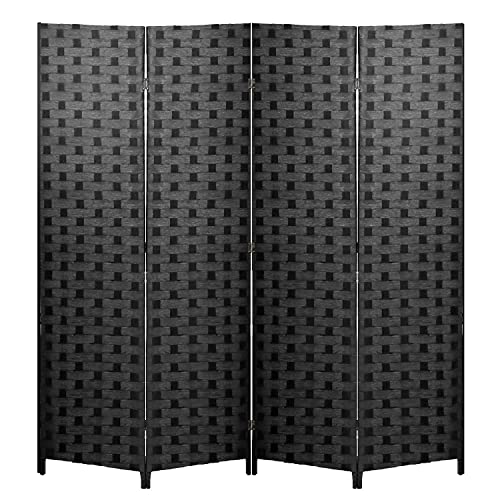
Seven bedroom dividers, split into two camps: freestanding folding screens and no-drill curtain-rod systems. The FDW leads, but the right pick depends on your ceiling and your floor space.

By Jadiel FranklinUpdated 16 min read
On this page
- Best room divider for bedrooms at a glance
- Screen or curtain: which one belongs in a bedroom?
- 1. FDW 4-Panel Folding Room Divider — Best overall
- 2. SUNALLY Room Divider for Separation 28-114in — Best upgrade
- 3. Daurore paw Room Divider for Room Separation — Best budget pick
- 4. JAUZVIL Room Divider Single Panel — Best minimal setup
- 5. AJAZZ Room Divider Curtain — Best premium
- 6. Rantila 2 Large Panels Room Divider — Best for pros
- 7. Womnwomn 4 Panel Room Divider — Runner-up
- How the seven picks were screened
- How much floor space does a folding screen eat?
- What the listings do not tell you
- When a different pick wins
- The verdict
- FAQ
The best room divider for bedrooms is the FDW 4-Panel Folding Room Divider, a freestanding screen that stands 70.2 in tall and weighs 15.4 lb, so it splits a room without touching a wall. If your bedroom opening is wide and you'd rather hang a curtain, the AJAZZ Room Divider Curtain ships with a no-drill tension rod and a 100 x 84 in blackout panel instead. Here's the 30-second shortlist: FDW for a standalone screen, SUNALLY for a wide curtain rod, JAUZVIL for the fastest setup.
Best room divider for bedrooms at a glance
| Pick | Type | Coverage | Price |
|---|---|---|---|
Best overall FDW 4-Panel Folding Room Divider |
Freestanding screen | 70.8 in W, 70.2 in H | Check Price |
Best upgrade SUNALLY Room Divider for Separation |
Curtain rod, no curtain | 28–114 in W claim | Check Price |
Best budget pick Daurore paw Room Divider |
Curtain rod, no curtain | 28–140 in W claim | Check Price |
Best minimal setup JAUZVIL Room Divider Single Panel |
Freestanding screen | 71 in W, 71 in H | Check Price |
Best premium AJAZZ Room Divider Curtain |
Curtain plus rod | 100 in W, 84 in L | Check Price |
Best for pros Rantila 2 Large Panels Room Divider |
Freestanding screen | 142 in W, 71 in H | Check Price |
Runner-up Womnwomn 4 Panel Room Divider |
Freestanding screen | 76.77 in H claim | Check Price |




Screen or curtain: which one belongs in a bedroom?
Here's the fork in the road. Three of these picks are rigid folding screens that stand on the floor. Three are curtain-rod systems that span an opening. One, the AJAZZ, is a curtain and rod sold together. The decision is not about looks. It's about what your room can physically accommodate.
A freestanding screen needs floor space and a flat run to stand on. It moves whenever you want, blocks a sightline instantly, and leaves no marks. But it eats square footage a small bedroom may not have.
A curtain-rod system, by contrast, spans a doorway or a gap using tension. It clears the floor entirely. The catch is a big one: two of the three rod systems here, the SUNALLY and the Daurore paw, ship without a curtain. You supply the fabric. The listings say so plainly.
- Screens: FDW, JAUZVIL, Rantila, Womnwomn
- Rod only, curtain not included: SUNALLY, Daurore paw
- Curtain and rod together: AJAZZ
Read that list twice before you buy. It's the single most common mistake in this category.
1. FDW 4-Panel Folding Room Divider — Best overall
A four-panel freestanding screen at 70.2 in tall that partitions a bedroom without a single hole in the wall.
Best for: renters who want a solid, movable partition with no installation Skip it if: your floor space is too tight for a freestanding screen
The FDW wins because it's the most complete answer in the set. It's a real screen, not a rod that expects you to buy a curtain separately. Four equal panels give a footprint of 70.8 in wide and 70.2 in tall, and the whole thing weighs 15.4 lb. That weight is the point. It's heavy enough to stand steady, light enough to fold flat and shift to another corner.
FDW says the panels are made of environmentally friendly wood and hand-crafted, and that the four hinged sections let you angle the screen into different shapes. Those are the maker's claims, not measured facts, but the published height and footprint tell the story that matters: this covers a full standing sightline.
Among the screens here it sits in the more expensive half, and it's the one buyers reach for most often across this set. The trade-off against the curtain-rod picks is floor space. A folding screen occupies the room, where a rod system spans a gap and touches nothing below the ceiling.
Pros:
- Freestanding screen, no drilling or curtain needed
- 70.2 in tall covers a full standing sightline
- Folds flat for storage between uses
- The one buyers choose most often here
- Four hinged panels angle into shapes
Cons:
- The dividing surface takes up floor space
- Sits in the more expensive half of the set
- Only one seller lists it
- Wood construction is a maker's claim, not verified
2. SUNALLY Room Divider for Separation 28-114in — Best upgrade
A no-drill tension rod that stretches from 28 in to 114 in wide, letting you hang your own curtain across a bedroom gap.

Best for: wide openings that need a curtain rod spanning up to 114 in Skip it if: you want the divider itself included in the box
The SUNALLY is a rod, not a screen, and that reframes what you're buying. It clears the floor completely and mounts by tension, so a rental wall stays untouched. SUNALLY says the height adjusts from 4 ft to 10 ft and the width from 28 in to 114 in, and that it's built from solid stainless steel. Those adjustment ranges are the maker's claims.
At 11.7 lb it's lighter than any screen here, because it's a frame rather than a panel. The reason it earns the upgrade slot over the budget rod is subtle: it's the second-cheapest pick, sells faster than most of this set, and several sellers stock it, which gives you options if one runs dry.
One line in the listing decides everything. The curtain is not included. You buy fabric separately, which means an extra shopping trip and an extra cost the rod alone doesn't show. Weigh that against a screen that arrives ready to stand.
Pros:
- No-drill tension mount, rental-safe
- Width adjusts up to 114 in claim
- Lightest published weight in the set at 11.7 lb
- Several sellers stock it
- Sells faster than most picks here
Cons:
- Curtain not included, you supply fabric
- Adjustment ranges are maker's claims
- No published height figure for the rod itself
- Needs a second purchase before it works
3. Daurore paw Room Divider for Room Separation — Best budget pick
The widest-spanning rod here, adjustable up to 140 in, and the cheapest pick in the whole set.

Best for: the widest doorless gaps, up to 140 in, on the lowest outlay Skip it if: you need the fabric or curtain supplied
The Daurore paw is the cheapest of the seven and covers the widest gap. Daurore paw says the width adjusts from 28 in to 140 in and the height from 48 in to 120 in, which is a wider span than the SUNALLY's claimed 114 in. If you're closing off a broad opening between a bedroom and an alcove, that extra reach counts. Those figures are the maker's claims.
It weighs 10.9 lb and the listing says it ships with a full set of mounting accessories and instructions. The maker also calls the rod solid stainless steel, rust-proof and durable. Read those as claims, not test results.
Here's the same catch as the SUNALLY, stated even more bluntly in the listing: curtains not included. You're buying the rod and the hardware. Factor a curtain into your budget before you decide it's the cheapest route, because the fabric can cost more than the rod. Only one seller lists it, so stock options are thin.
Pros:
- Cheapest pick in the set
- Widest span here, up to 140 in claim
- Includes mounting accessories per the listing
- Light at 10.9 lb
- No-drill install, rental-safe
Cons:
- Curtains not included, fabric is extra
- Only one seller lists it
- Adjustment figures are maker's claims
- No stated warranty
4. JAUZVIL Room Divider Single Panel — Best minimal setup
A single 71 x 71 in freestanding fabric panel that stands up in seconds and blocks one sightline cleanly.
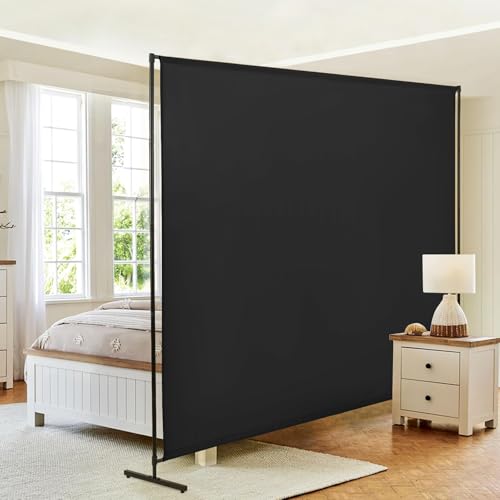
Best for: a quick single-zone block in a small bedroom Skip it if: you need to cover more than 71 in of width
The JAUZVIL strips the idea down to one panel. It measures 71 in wide and 71 in tall, weighs just 5.75 lb, and is the second-cheapest pick here. That light weight is the whole pitch. You lift it with one hand and set it wherever you need a screen right now.
JAUZVIL says the height is adjustable, the feet are removable, and the fabric is high-density and opaque so nothing shows through. It also claims tool-free assembly. Those are the maker's descriptions. What's verified is the footprint: a single 71 in span, no folding, no multiple hinges.
That single panel is also the limit. Where the FDW gives you four panels to angle around a corner, the JAUZVIL covers one flat line and no more. It's the lightest screen in the set and the fastest to deploy, but it trades reach and shaping for that simplicity. For a narrow gap beside a bed, that's a fair swap. For a wide open-plan bedroom, it falls short.
Pros:
- Lightest screen here at 5.75 lb
- Second-cheapest pick
- Opaque no-see-through fabric claim
- Removable feet and adjustable height claim
- Fastest single-panel setup
Cons:
- Covers only one 71 in span
- No folding or angling like multi-panel screens
- Only one seller lists it
- Higher sales position than most rivals
5. AJAZZ Room Divider Curtain — Best premium
The only pick that ships as a complete kit: a 100 x 84 in blackout curtain with its own no-drill tension rod.

Best for: light-sensitive sleepers who want a blackout curtain with its rod Skip it if: you want a rigid screen you can fold and stand freely
The AJAZZ solves the problem the SUNALLY and Daurore paw create. It's the one curtain system here that includes both the fabric and the rod. The panel is 100 in wide and 84 in long, and the whole thing weighs 11 lb. AJAZZ says the fabric is 100% blackout with a triple-weave sound-dampening layer, and the tension rod adjusts in height and width with no drilling. Those are the maker's claims, but the completeness is real: nothing else to buy.
It's the most expensive pick in the set, and that premium buys the blackout fabric and the packaged rod rather than any extra spec on paper. For a sleeper bothered by light, a blackout weave earns its keep in a way a bare screen can't.
The trade-off is form. A hung curtain sways and needs a fixed span to tension against. A screen stands anywhere and folds away. If you want to move your divider around the room, the AJAZZ is the wrong tool. Only one seller lists it.
Pros:
- Only pick with curtain and rod included
- 100% blackout fabric claim for light-sensitive sleepers
- Triple-weave sound-dampening layer claim
- No-drill tension rod, rental-safe
- 100 in wide coverage
Cons:
- Most expensive pick in the set
- Curtain form sways, unlike a rigid screen
- Only one seller lists it
- Needs a fixed span to tension against
6. Rantila 2 Large Panels Room Divider — Best for pros
A two-panel freestanding screen spanning 142 in wide, built to close off the biggest bedroom openings.

Best for: spanning a wide 142 in run with a two-panel folding screen Skip it if: you have a narrow nook where two large panels won't fit
The Rantila trades panel count for panel size. Two large panels give a total span of 142 in wide and 71 in tall, the widest screen coverage in this group. If you're sectioning off a large open bedroom or a studio corner, that reach is what you're paying for. It weighs 16 lb, the heaviest pick here, which is the cost of covering that much width in fabric and frame.
Rantila says the fabric is water-resistant, tear-resistant and non-see-through, with a high-density polyethylene weave and a PA coating. The listing includes step-by-step instructions with pictures. Those are maker's claims. It sits in the more expensive half of the set.
The catch is the flip side of the width: two large panels don't shrink well. Where the FDW's four narrower panels fold and angle into a tight corner, the Rantila's two big panels want a wide, flat run. Drop it into a small bedroom and it dominates. This is a pick for big spaces, and it says so in the dimensions.
Pros:
- Widest screen span here, 142 in
- Water-resistant, tear-resistant fabric claim
- Non-see-through polyethylene weave claim
- Folds and turns either direction
- Illustrated instructions included
Cons:
- Heaviest pick at 16 lb
- Two large panels won't fit tight corners
- Sits in the more expensive half
- Higher sales position than the FDW
7. Womnwomn 4 Panel Room Divider — Runner-up
A four-panel freestanding folding screen with dual-way hinges that fold in either direction.

Best for: a folding four-panel screen with dual-way hinges Skip it if: you want a full set of published measurements before buying
The Womnwomn is a four-panel screen in the FDW mould, and its hinge design is the difference it leans on. Womnwomn says the panels use flexible dual-way hinges that fold in either direction, which lets you shape the screen around a corner or wrap it into a nook. The listing also cites a size of 76.77 in high by 75.6 in wide and a rust-resistant metal frame with opaque fabric. Those are the maker's figures.
It sits mid-range on price in this set. That's a reasonable position for a four-panel screen with the flexibility the FDW offers.
Why runner-up rather than higher? The published data is thin. The confirmed dimensions read 37 x 5.4 in, which describe the folded or boxed form rather than the standing screen, and there's no confirmed weight. The full standing size lives only in the maker's copy. Against the FDW, whose height and footprint are both stated outright, the Womnwomn asks you to trust the listing text for the numbers that matter most. It's the slowest seller of the seven, too.
Pros:
- Four panels with dual-way hinges claim
- Folds either direction to shape corners
- Mid-range price in this set
- Opaque fabric on a metal frame claim
Cons:
- Confirmed dimensions describe the folded form only
- No verified standing weight
- Full standing size is a maker's claim
- The slowest seller of the seven
How the seven picks were screened
I lined up the published specifications for all seven side by side and sorted them into two structures before anything else: rigid freestanding screens and curtain-rod systems. That split does most of the work, because the two types solve the bedroom problem in opposite ways.
From there, three things shaped the ranking.
- Completeness. A pick that arrives ready to use beat one that needs a second purchase. That's why the FDW leads and the two curtain-free rods sit lower.
- Verified coverage. Screens with a stated standing height and footprint ranked above those whose full size lived only in the listing copy.
- Fit to a real bedroom. Width that's too much or too little for the space it targets counts against a pick, so the widest and the single-panel options landed with clear conditions attached.
Nothing here carries a published warranty, so warranty didn't sort the field. Neither did colour: every pick is black. What separated them was structure, stated size, and whether the box holds a working divider or half of one.
How much floor space does a folding screen eat?
How much floor space a folding screen takes is the question that decides whether a screen even fits your bedroom. A rod system spans a gap and touches nothing below the ceiling. A screen stands on the floor and occupies it.
The footprints here vary widely. Use the stated widths as your guide:
- JAUZVIL: a single 71 in panel, the smallest standing footprint
- FDW: four panels across 70.8 in, folds to angle around a corner
- Womnwomn: four panels, maker's width of 75.6 in
- Rantila: two large panels across 142 in, the biggest footprint
Measure your open floor before you choose. A 142 in Rantila run needs a wall's worth of clear space. The FDW's four narrower panels fold inward, so you can bend them into an L and tuck the screen against a bed's foot. For a cramped bedroom, that folding flexibility matters more than raw width. Pace out the span with a tape measure first.
What the listings do not tell you
A room divider listing hides as much as it shows. Read these gaps before you commit.
None of the seven publishes a warranty. That's not unusual for the category, but it means you're relying on the seller's return policy, so check it at checkout. The Rantila and Womnwomn listings mention replacement of missing or defective parts, which is a support claim, not a formal guarantee.
The curtain-free rods are the biggest trap. SUNALLY and Daurore paw both state, in plain text, that curtains are not included. A shopper skimming the width range can easily miss it and end up with a bare rod. The AJAZZ, by contrast, includes both curtain and rod.
Stability is unstated across the board. A freestanding screen's steadiness depends on its base and weight, and only the FDW, JAUZVIL, and Rantila publish a weight. The Womnwomn's confirmed figures describe the folded form, so its standing footprint is a maker's claim. When the spec is missing, don't assume. Restructure your expectations around what's actually printed.
When a different pick wins
The FDW is the default, but four conditions flip it.
- If your opening is wider than any screen and you'd rather hang fabric, the SUNALLY rod spans up to a claimed 114 in and clears the floor. Add a curtain to your cart.
- If cost is the hard limit and you already own or will buy a curtain, the Daurore paw is the cheapest pick and reaches a claimed 140 in.
- If light wakes you and you want one box that solves it, the AJAZZ is the only complete curtain kit, with a blackout weave AJAZZ claims blocks 100% of light.
- If you need to close off a very large open bedroom, the Rantila's two panels span 142 in, the widest screen coverage here.
Each of those is a real, checkable condition. Measure your gap, decide screen or curtain, and confirm whether the fabric ships in the box. Those three checks settle it.
The verdict
If you want a divider that arrives ready to stand and moves whenever you like, the FDW 4-Panel Folding Room Divider is the pick. It's a complete screen at 70.2 in tall and 15.4 lb, heavy enough to stay put, light enough to reposition, and it's the one buyers here reach for most often. No drilling, no second purchase, no wall damage.
If you sleep light and want a blackout barrier, the AJAZZ Room Divider Curtain is the better buy. It's the only pick that ships curtain and rod together, and AJAZZ claims a 100% blackout, sound-dampening weave across a 100 in span. That completeness is its exact advantage over the SUNALLY and Daurore paw rods, which arrive without any fabric at all.
The cutoff is your floor plan. Below a certain amount of open floor, a freestanding screen won't fit, and a tension-rod curtain that spans a fixed gap wins. Above it, a movable screen like the FDW gives you flexibility a hung curtain can't. Measure the space first, then decide screen or curtain. That single measurement, not brand or price, is what settles this category.
FAQ
Is a room divider for bedrooms worth it over a curtain alone?
A room divider for bedrooms is worth it when you need a movable, freestanding barrier rather than a fixed curtain. A screen like the FDW stands anywhere and folds away, no wall contact required. A bare curtain needs a rod and a fixed span to hang from. If flexibility matters more than blackout, the screen earns its place.
What is the cheapest room divider for bedrooms here?
The cheapest room divider for bedrooms in this set is the Daurore paw, a no-drill tension rod that spans a claimed 28 in to 140 in. Read the listing closely first: curtains are not included, so you'll buy fabric separately. Once you add a curtain, the total can exceed a complete kit, so price the whole solution before you decide.
How much width does the FDW cover compared to the Rantila?
The FDW covers 70.8 in of width across four panels, while the Rantila spans 142 in across two large panels, roughly double the reach. The FDW's narrower panels fold and angle into a corner, so they suit tight bedrooms. The Rantila's wide run needs a full wall of clear floor. Choose by the space you actually have.
Do these dividers require drilling or wall damage?
These dividers require no drilling in either format. The freestanding screens, like the FDW and JAUZVIL, stand on the floor and touch no wall. The curtain-rod systems, the SUNALLY, Daurore paw, and AJAZZ, mount by tension and leave no holes. Every pick here is safe for a rental. Just confirm the rod tensions firmly against your span.
Does the divider work as a full privacy screen in a bedroom?
The divider works as a privacy screen in a bedroom when the fabric is opaque and the height covers a standing sightline. The FDW stands 70.2 in tall, and JAUZVIL claims a no-see-through weave. The blackout picks add light control. Remember: the SUNALLY and Daurore paw rods ship without fabric, so they can't block a view until you add a curtain.
Start by measuring the exact gap you want to close and the open floor beside it. That one step tells you whether a freestanding screen or a tension-rod curtain fits your room, and it's the check most shoppers skip. If the space allows a standing screen, the FDW is the safe default: a complete 70.2 in barrier that folds flat, moves on a whim, and leaves your walls untouched. No fabric to buy, no tools, no holes. For most bedrooms, that combination of readiness and flexibility is exactly what a divider should deliver.