Best Room Divider for a Small Apartment Layout

Six room dividers compared on footprint, weight, and how they actually behave in a rental. A folding bamboo screen leads, with picks for renters, storage-hungry studios, and curtain fans.

By Jadiel FranklinUpdated 15 min read
On this page
- How I narrowed six dividers down to one winner
- Best room divider for small apartments living at a glance
- What actually decides a divider in a small apartment?
- 1. Furnnylane 6 Panel Bamboo Room Divider — Best overall
- 2. Goovilla Room Divider — Best budget pick
- 3. SUNALLY Room Divider 28-114in — Runner-up
- 4. JILRON No-Drill Room Divider Curtains Set — Best for heavy use
- 5. SUNALLY 4 Panel Privacy Screen — Best for beginners
- 6. Tribesigns Room Divider with Shelves — Best premium
- Does a divider give you real privacy?
- Folding screen or tension curtain: which fits a rental?
- What the listings leave out
- The verdict
- FAQ
The best room divider for small apartments living is the Furnnylane 6 Panel Bamboo Room Divider, because it folds out to 92.1 in wide, weighs under 21 lb, and needs no assembly at all. If you want the cheapest floor-to-ceiling divide instead, the Goovilla tension divider costs the least here and packs down to a 16.5 in box. What decides this category isn't looks. It's footprint, weight, and whether the thing survives a move.
How I narrowed six dividers down to one winner
I lined up the published specifications for all six dividers side by side, then cut on the traits that matter in a tight floor plan. Three things got picks disqualified from the top spot.
First, weight you can't move. A divider you can't reposition alone is a wall you regret. The Tribesigns unit weighs 71.7 lb, which rules it out for renters. Second, span that overshoots the room. A 114 in tension rod is useless in a studio that's 90 in across. Third, missing parts. Two of these listings ship a rod with no curtain, which is a hidden second purchase.
What survived split into three shapes:
- Folding screens: rigid panels that fold flat, no tools.
- Tension systems: floor-to-ceiling rods, no drilling.
- Storage dividers: shelves that double as a partition.
Each shape suits a different small-apartment problem. The best room divider for small apartments living is the one whose shape matches your room, so I ranked for the most common case first: a renter who wants privacy without holes in the wall.
Best room divider for small apartments living at a glance
| Pick | Type | Footprint / span | Price |
|---|---|---|---|
Best overall Furnnylane 6 Panel Bamboo Room Divider |
Folding screen | 67 in H x 92.1 in W | Check Price |
Best budget pick Goovilla Room Divider |
Tension rod | 28–114 in W, 4–10 ft H | Check Price |
Runner-up SUNALLY Room Divider 28-114in |
Tension rod | 28–114 in W, 4–10 ft H | Check Price |
Best for heavy use JILRON No-Drill Curtain Set |
Curtain + rod kit | 72–200 in W, 43–120 in H | Check Price |
Best for beginners SUNALLY 4 Panel Privacy Screen |
Folding screen | 71.3 in H x 88 in W | Check Price |
Best premium Tribesigns Room Divider with Shelves |
Storage shelf | 47.2 in W x 70.9 in H | Check Price |


What actually decides a divider in a small apartment?
Most guides compare height and colour. That's not what decides it. In a small space, three specs matter more than looks.
Footprint when it's not in use. A folding screen collapses flat against a wall. A tension rod packs into a 16.5 in box. A shelf divider stays put and eats floor. If you rearrange often, this is the number to read first.
Weight. You'll move a divider more than you think. Under 21 lb, one person handles it. Past 70 lb, you're recruiting help.
Whether it damages the wall. Renters lose deposits over drill holes. Every tension and folding pick here is no-drill.
The obvious spec, height, misleads because a taller divider isn't better in a room with an 8 ft ceiling. It just costs more to store. The best room divider for small apartments living wins on footprint and weight, not stature.
1. Furnnylane 6 Panel Bamboo Room Divider — Best overall
The Furnnylane wins because it unfolds to 92.1 in of coverage, weighs under 21 lb, and asks nothing of your walls or your toolbox.
Best for: renters who want zero assembly and a screen that moves easily Skip it if: you need it to break up a very long wall in one go
This is the only pick here made of natural bamboo, and it's the only folding screen that ships ready to use. The listing describes six panels expanding to 67 in tall by 92.1 in wide, each panel 15.35 in across. Furnnylane says the frame is hand-sanded solid pinewood with reinforced metal hinges and non-slip base pads for hardwood, tile, or carpet. That combination is why it earns the top spot in a small apartment: you unfold it, angle it around a bed or desk, and you're done.
Weight is the quiet advantage. At under 21 lb it's the lightest rigid screen here, so you reposition it alone when the room changes function. The brand also claims no chemical paints or synthetic glues, which matters in a space you sleep and breathe in.
The trade-off against the tension picks is span in a straight line. It maxes at 92.1 in wide, so it can't wall off a long open-plan run the way a 114 in rod can. It also can't touch the ceiling. For most studios that's fine. For a loft, it isn't.
Pros:
- Lightest rigid screen here, under 21 lb
- No assembly, unfolds ready to stand
- Natural bamboo with pinewood frame
- 92.1 in span from six angled panels
- Non-slip pads for hardwood, tile, carpet
Cons:
- Caps at 92.1 in, won't span a long wall
- Only 67 in tall, no ceiling contact
- The most expensive folding screen here
- Only two sellers list it
2. Goovilla Room Divider — Best budget pick
The Goovilla is the cheapest divider here and adjusts from 4 to 10 ft tall, so it fits ceilings a folding screen can't reach.

Best for: renters wanting the cheapest floor-to-ceiling divide Skip it if: you have angled or vaulted ceilings
This is a tension system, not a panel, and it's the least expensive of the six. Goovilla lists a height range of 4 to 10 ft and a width range of 28 to 114 in, which is far wider than any folding screen here. It weighs 11.7 lb and packs into a 16.5 in box, the smallest stored footprint in this set. For a renter who moves yearly, that's a genuine edge.
The brand says it uses floor-to-ceiling tension with no drilling, so it leaves no holes. Setup comes with instructions and a full set of mounting hardware. The listing is blunt about one limit: it's not for angled or vaulted ceilings, and it needs a hard surface at top and bottom.
The honest catch is that curtains are not included. You're buying the rod and brackets, then sourcing fabric separately. That's the price of the low sticker. Against the JILRON kit, which bundles both, the Goovilla asks more of you before it works.
Pros:
- Cheapest divider in this set
- Adjusts 4–10 ft tall, 28–114 in wide
- Packs into a 16.5 in box
- No drilling, no wall damage
- Light at 11.7 lb
Cons:
- Curtains not included, a second purchase
- Not for angled or vaulted ceilings
- Needs hard surfaces top and bottom
- Nothing to divide until you add fabric
3. SUNALLY Room Divider 28-114in — Runner-up
The SUNALLY tension rod matches the widest span in this class and uses a stainless steel rod the brand calls rust-proof.

Best for: wide openings that need a tension rod spanning up to 114 in Skip it if: you want a rigid panel instead of a curtain rod
This is the second-cheapest pick here and the strongest seller of the six, so it's the divider buyers reach for most in this set. It's a close cousin of the Goovilla: a no-drill tension rod with a 4 to 10 ft height range and a 28 to 114 in width range. SUNALLY says the rod is solid stainless steel, rust-proof and durable, which is a step up in claimed material from a plain steel tube.
It weighs 11.7 lb and installs in minutes with no tools, per the listing. For a rental with a wide opening between living and sleeping zones, that 114 in reach is the appeal. It defines the space without a single fixing.
Same honest limit as the Goovilla: curtains are not included. You supply the fabric. The reason it lands as runner-up rather than best budget is simply price position, it costs a little more, while giving you the same span and a stainless rod. If the small difference buys peace of mind on rust, take it.
Pros:
- Spans up to 114 in wide
- Stainless steel rod, brand calls it rust-proof
- The fastest seller in this set
- No tools, installs in minutes
- Light at 11.7 lb
Cons:
- Curtains not included
- Costs more than the Goovilla for the same span
- Only a rod, not a rigid divider
- Needs firm surfaces to tension against
4. JILRON No-Drill Room Divider Curtains Set — Best for heavy use
The JILRON is the only pick that arrives complete: two curtain panels and a full bracket set in one box, with the widest range here.

Best for: studios wanting a full curtain-and-rod kit in one box Skip it if: you prefer a solid screen you can fold flat
Every other tension pick here makes you buy fabric separately. The JILRON doesn't. It ships as a kit: two panels sized 100 in W x 84 in L, plus adjustable pole brackets. The listing gives an adjustable range of 72 to 200 in wide and 43 to 120 in tall, the biggest span of any divider in this roundup. That's enough to close off an entire open-plan wall.
It's the heaviest of the soft dividers at 18.7 lb, which reflects the two-panel curtain load. JILRON says integrated magnets pull the panels shut so the seam stays closed, which is the detail that separates a real privacy screen from gapping fabric. For a studio where you open and close the divide daily, that closing action earns the "heavy use" label.
The trade-off is that fabric never feels as solid as a panel. It sways, it doesn't stand on its own, and you can't fold it flat like the Furnnylane. Only one seller lists it, too. If you want something rigid, look up the list.
Pros:
- Complete kit, curtain and brackets included
- Widest range here, 72–200 in wide
- Magnetic closure keeps panels shut
- No drilling, tension-mounted
- 84 in curtain drop for tall openings
Cons:
- Fabric sways, no rigid panel
- Heaviest soft divider at 18.7 lb
- Only one seller lists it
- Can't fold flat for storage
5. SUNALLY 4 Panel Privacy Screen — Best for beginners
The SUNALLY 4-panel screen ships with all hardware and instructions, and uses a coated polyester the brand says blocks visibility completely.
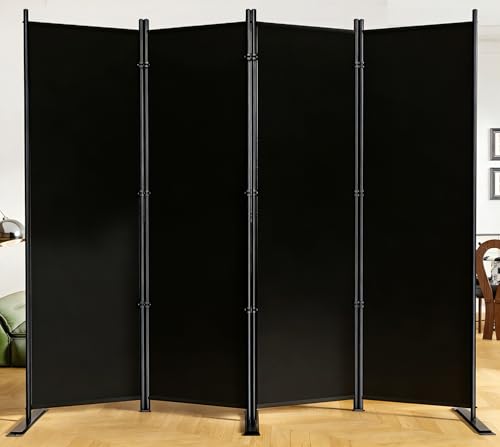
Best for: first-timers who want hardware and instructions included Skip it if: you need a wider span than 88 in
This is a folding screen like the Furnnylane, but built differently and priced roughly mid-range for this set. Four panels reach 71.3 in tall by 88 in wide. SUNALLY describes a reinforced steel frame with a powder-coated finish for scratch and rust resistance, wrapped in high-density polyester with a PA coating the brand says is non-see-through.
The reason it's the beginner pick is the closing sentence in its listing: all hardware and instructions are included for quick setup, and SUNALLY offers replacement parts if anything arrives defective. Multi-buckle hinges let the panels angle to any position, so you can bend it around a corner or stand it in a zigzag for stability. For someone setting up their first divide, that flexibility forgives a lot of guesswork.
Against the Furnnylane, it's shorter on span, 88 in versus 92.1 in, and the fabric-over-steel build feels less premium than solid bamboo. It's also taller at 71.3 in, which some will prefer. The trade-off is material: cloth panels can dent and stain where bamboo shrugs it off.
Pros:
- All hardware and instructions included
- Coated polyester, brand calls it non-see-through
- Steel frame, powder-coated finish
- Hinges angle panels to any position
- Taller than the winner at 71.3 in
Cons:
- Narrower span than the winner, 88 in
- Fabric panels can dent or stain
- No published weight to judge portability
- Only two sellers list it
6. Tribesigns Room Divider with Shelves — Best premium
The Tribesigns is the only pick that works as furniture, with open shelves across a 70.9 in tall frame that also splits the room.

Best for: studios that want a divider doubling as a bookshelf Skip it if: you rent and move often
This is the outlier. It's the most expensive pick here and the only one that gives you storage. Tribesigns lists a frame of 47.2 in W x 11.8 in D x 70.9 in H, built from MDF and thickened metal tubing, with open shelves for books, plants, or framed photos. Vertical metal bars keep it feeling airy rather than walled off, which is what you want when floor space is scarce.
In a small apartment, a divider that also stores things earns its footprint twice. You stop buying a separate bookshelf. The clean-lined, open design reads as intentional furniture, not a temporary screen.
The catch is weight and permanence. At 71.7 lb it's by far the heaviest pick, six times the tension rods, so it's not something you drag around casually. It requires assembly, and only one seller lists it. This is a divider you commit to a spot, not one you fold away. If you move often, that weight works against you, and the narrower 47.2 in span won't close a wide opening on its own.
Pros:
- Only pick with real storage shelves
- Open vertical-bar design stays airy
- MDF and thick metal tubing build
- 70.9 in tall, 11.8 in deep for books
- Doubles as furniture, saves buying a shelf
Cons:
- Heaviest here at 71.7 lb
- Requires assembly
- Narrow 47.2 in span
- Only one seller lists it
Does a divider give you real privacy?
Real privacy depends on the material, not the label. Here's how the picks stack up on actually blocking a sightline.
- Solid panels win. The Furnnylane's bamboo and the SUNALLY 4-panel's coated polyester both block a direct view. SUNALLY calls its screen non-see-through.
- Curtains close, then gap. The JILRON uses magnets to hold its two panels shut, which fixes the centre gap most curtain dividers leave.
- Bare rods do nothing alone. The Goovilla and SUNALLY tension rods ship without fabric, so privacy is whatever curtain you hang.
None of these blocks sound. A divider defines space and hides a bed; it doesn't soundproof a studio. If you share a wall with a roommate, set expectations there. For visual privacy in the best room divider for small apartments living, a solid folding panel does the most with the least fuss.
Folding screen or tension curtain: which fits a rental?
Folding screen or tension curtain comes down to how your room is shaped and how often you move.
Pick a folding screen if you want something freestanding you can angle and fold flat. The Furnnylane and SUNALLY 4-panel both stand on their own and store against a wall. No ceiling contact needed.
- Measure the gap you want to cover.
- If it's under 92 in, a folding screen fits.
- If it's wider, or you want floor-to-ceiling coverage, go tension.
Pick a tension system if the opening is wide or you want the divide to reach the ceiling. The Goovilla and SUNALLY rods stretch to 114 in; the JILRON kit reaches 200 in. All three are no-drill, so your deposit is safe. Just confirm you have flat, hard surfaces top and bottom, since none of them work on angled ceilings.
What the listings leave out
A few gaps in the product data are worth flagging before you buy, because no listing here fills them.
- Sound. None of these claims any noise reduction. Treat every one as a visual divider only.
- Curtain fabric. The two tension rods list curtains as not included. Budget for that, or start with the JILRON kit that bundles both.
- Weight, sometimes. The SUNALLY 4-panel screen publishes no weight, so I can't tell you how portable it is versus the under-21-lb Furnnylane.
- The keyword's promise. Amazon's search treats "small apartments living" loosely, so a few of these list spans up to 200 in built for big rooms. Read the footprint against your actual floor plan; a divider sized for a loft is wrong for a studio.
Measure twice. A divider that overshoots your room is as useless as one that falls short.
The verdict
The best room divider for small apartments living is the Furnnylane 6 Panel Bamboo Room Divider. It folds out to 92.1 in of coverage, weighs under 21 lb, and stands ready with no assembly and no wall damage. In a space where you rearrange furniture as the room changes jobs, that lightness and instant setup beat everything else here. It's a screen you actually move, not a wall you resent.
Two conditions flip the choice. If your opening is wider than a folding screen can span, or you want the divide to touch the ceiling, the SUNALLY tension rod reaches 114 in and mounts with no drilling; just add a curtain. And if you'd rather your divider earn its floor space twice, the Tribesigns shelf unit stores books and plants across a 70.9 in frame, though at 71.7 lb it's a commitment, not a screen you fold away.
The runner-up's real advantage over the winner is reach. The SUNALLY rod spans 114 in to the Furnnylane's 92.1 in and climbs to a 10 ft ceiling. If your room needs that stretch, the winner simply can't deliver it.
FAQ
What is the best room divider for a small apartment on a budget?
The best room divider for a small apartment on a budget is the Goovilla tension system, the cheapest of the six here. It adjusts from 4 to 10 ft tall and 28 to 114 in wide, weighs 11.7 lb, and packs into a 16.5 in box. Remember curtains aren't included, so budget for fabric separately.
Is a folding screen room divider worth it in a studio?
A folding screen room divider is worth it in a studio when you rearrange often. The Furnnylane weighs under 21 lb, folds flat against a wall, and needs no assembly or drilling. You angle it around a bed or desk and reposition it alone. The trade-off is span: it caps at 92.1 in, so it can't wall off a very wide opening.
How wide can these room dividers reach?
These room dividers reach very different widths. The folding screens cover 88 to 92.1 in. The two SUNALLY and Goovilla tension rods stretch from 28 to 114 in. The JILRON curtain kit goes furthest, adjustable from 72 to 200 in. Measure your opening first, then match the span, since a divider built for a loft overshoots a small studio.
Furnnylane or Goovilla: which divider should I pick?
Furnnylane or Goovilla depends on your ceiling and your walls. The Furnnylane is a freestanding bamboo screen, under 21 lb, no assembly, best when you want a rigid divide you can move and fold. The Goovilla is a floor-to-ceiling tension rod, cheaper, best for wide or tall openings, but it needs a separate curtain and won't work on angled ceilings.
What mistake do small-apartment buyers make with dividers?
The biggest mistake small-apartment buyers make is buying for width, not footprint. A 200 in span sounds generous until it dominates a 90 in room. Check the stored size and weight first: the Tribesigns weighs 71.7 lb and won't move, while the folding and tension picks pack away. Also confirm whether a curtain is included before you check out.
Start by measuring the exact gap you want to close and noting your ceiling type. That one step points you straight at the right shape: a folding screen for a modest, movable divide, a tension rod for a wide or tall opening, a shelf unit if you want storage in the bargain. For most renters in a tight floor plan, the Furnnylane is the safe default, because it does the job the moment you unfold it and moves with you when the room, or the apartment, changes.