Best Room Dividers by Panel Count and Height

Six freestanding and tension-rod room dividers compared on panel count, height and footprint, with a clear winner for renters and a runner-up for wide, open-plan splits.

By Jadiel FranklinUpdated 16 min read
On this page
- Best room dividers at a glance
- How I screened the listings down to six
- Best room dividers: what actually decides it
- 1. VEVOR Room Divider — Best overall
- 2. SUNALLY Room Divider Curtain Rod — Best budget pick
- 3. Roundhill Oriental Shoji 4 Panel Screen — Best upgrade
- 4. Grezone Room Divider — Most versatile
- 5. MAYOLIAH 6 Panel Folding Privacy Screen — Best for families
- 6. Roundhill Japanese 4-Panel Screen, Plum Blossom — Best premium
- Freestanding panels or a tension-rod curtain?
- How much wall are you really trying to cover?
- What the listings do not tell you about stability
- Which style suits which room?
- The verdict
- FAQ
The best room dividers here are the VEVOR 4 Panel Room Divider, which stretches to 136.4 in wide and 72.4 in tall on an Oxford-fabric-over-frame build that folds flat for storage. If you rent and cannot leave a freestanding footprint on the floor, the SUNALLY tension-rod divider adjusts from 4 to 10 ft in height and 28 to 70 in in width without a single drilled hole. The deciding specification is not panel count. It is how tall you need the split, and whether the divider stands on the floor or braces against the ceiling.
Best room dividers at a glance
| Pick | Height | Width open | Price |
|---|---|---|---|
Best overall VEVOR Room Divider |
72.4 in | 136.4 in (4 panels) | Check Price |
Best budget pick SUNALLY Room Divider Curtain Rod |
4–10 ft adjustable | 28–70 in adjustable | Check Price |
Best upgrade Roundhill Oriental Shoji 4 Panel Screen |
71 in | 68 in (4 x 17 in) | Check Price |
Most versatile Grezone 6 Panel Folding Privacy Screen |
71 in | 200 in (6 panels) | Check Price |
Best for families MAYOLIAH 6 Panel Folding Privacy Screen |
71 in | 120 in (6 panels) | Check Price |
Best premium Roundhill Japanese 4-Panel Screen, Plum Blossom |
71 in | 71 in (4 x 18 in) | Check Price |


How I screened the listings down to six
I pulled every listing tagged under Bedroom Furniture > Room Dividers and cut anything without published height and width figures. That alone dropped most decorative screens. What I wanted was a set that let a reader compare footprint honestly, so I kept picks that publish either both dimensions or an adjustable range with clear bounds.
From there, three cuts:
- No listed panel dimensions? Cut. A 71 in overall height means little if the panel widths are guesses.
- No frame material named in the feature bullets? Cut. Powder-coated iron, wood and stainless steel behave differently on a hard floor.
- Duplicates from the same brand at the same panel count? Cut. Two Roundhill screens survived because one is 17 in per panel and one is 18 in per panel, and they use different opaque materials.
Six picks came through: four freestanding folding screens, one wide six-panel workhorse, and one no-drill tension rod for renters. That mix is not padding. It maps to the three ways people actually split a room.
Best room dividers: what actually decides it
Panel count sells the listing. Height and footprint decide the room.
A 71 in screen with four 17 in panels covers 68 in when fully opened. Push the same panel count to 18 in each and you gain 4 in of width. Move to six panels at 20 in each and you cover 120 in. That difference is the whole story: a bedroom corner needs 60 to 80 in of coverage, a studio splitting a bed from a workspace often needs 100 to 140 in, and a classroom or family room can want 200 in. Buy the panel count that matches the wall, not the one that looks impressive in the photo.
Height matters just as much. Every folding screen in this set is 71 to 72.4 in tall. That covers a seated sightline and a standing sightline for most rooms with 8 ft ceilings, but it leaves 20 to 25 in of open air above. If you need a true floor-to-ceiling split, only the SUNALLY tension rod reaches 10 ft, and it needs a curtain you supply separately.
1. VEVOR Room Divider — Best overall
A four-panel Oxford-fabric screen that opens to 136.4 in wide and stands 72.4 in tall, at the second-cheapest position in this set.
Best for: a bedroom or home-office corner that needs a solid, opaque split Skip it if: you rent and cannot store a 21.4 lb folded screen
The VEVOR wins this set on the width-to-price ratio. Four panels give you 136.4 in fully extended, which is 68.4 in more coverage than the shorter Roundhill Shoji and 16.4 in more than the six-panel MAYOLIAH, from a screen that sits at the entry position on price. VEVOR describes the fabric as Oxford weave and calls it waterproof, which is a manufacturer claim rather than a rating. The panels each measure 34 in wide by 72.4 in tall, and the listing says assembly takes about 15 minutes with two people.
Against the rest of the set, the trade-off is style. This is a plain grey utility screen, not a Japanese shoji or an iron-frame partition. It also weighs 21.4 lb folded, which is heavier than the Roundhill picks and the SUNALLY rod. In return you get the widest freestanding coverage under the entry price band, and the one product here that pairs a full 72 in height with a genuinely large footprint.
Pros:
- Widest freestanding coverage in this set at 136.4 in
- Second-cheapest of the six
- Oxford fabric claim, brand states waterproof
- Panels each 34 in wide, useful for large corners
- Folds flat for storage per listing
Cons:
- 21.4 lb folded, heaviest fabric screen here
- Only two sellers list it
- Plain utility look, no decorative pattern
- Listing recommends two people for assembly
2. SUNALLY Room Divider Curtain Rod — Best budget pick
A no-drill tension rod that extends from 4 to 10 ft tall and 28 to 70 in wide, sold without a curtain.

Best for: renters who need a floor-to-ceiling split with no wall damage Skip it if: you need the divider itself to block the view
The SUNALLY is the odd one out and the most useful pick for anyone renting. It is the cheapest of the six and the only one that reaches ceiling height, from 4 ft to 10 ft, on a stainless-steel body the brand describes as rust-proof. Width adjusts from 28 in to 70 in. It weighs 7.48 lb, the lightest here by more than 3 lb, and the listing says tools are not required to install or remove it.
The catch is right in the listing: curtains are not included. What you are buying is the mechanism, and the fabric is on you. That gives you full control over opacity, colour and drape, but it also means the divider itself does nothing until you hang something from it. Against the freestanding screens, the SUNALLY sacrifices instant privacy for a truly floor-to-ceiling split and zero drilled holes, which is often the exact trade a renter needs.
Pros:
- Cheapest of the six
- Height adjusts 4 to 10 ft, only true ceiling reach here
- No drilling, safe for rentals
- Stainless steel, brand states rust-proof
- Lightest pick at 7.48 lb
Cons:
- Curtain not included, extra purchase required
- Only one seller listed
- Tension mount needs a compatible ceiling
- Width caps at 70 in
3. Roundhill Oriental Shoji 4 Panel Screen — Best upgrade
A shoji-style screen with a natural wood frame and heavy-duty rice paper panels, 71 in tall with four 17 in panels.

Best for: a living room where the divider is part of the decor Skip it if: you have kids or pets who will test the rice paper
Step up from the VEVOR and you buy looks. This Roundhill sits at the middle price position and pairs a natural wood frame with what the brand calls fibre glass-like heavy-duty rice paper. Each of the four panels is 17 in wide, so the full opened footprint runs to 68 in of coverage at 71 in tall. It weighs 15 lb, roughly a third less than the VEVOR, which makes it noticeably easier to reposition on a hard floor.
The trade against the VEVOR is coverage: you lose more than 5.5 ft of width and gain a decorative object instead. The trade against the pricier Plum Blossom version is opacity and pattern; the natural finish is plainer, and the paper reads as translucent rather than opaque. Rice paper is also a real durability question, which the listing does not address. In a household without small hands or claws, it should hold up. In one with either, expect punctures.
Pros:
- Wood frame with rice paper panels
- Ready to use, no assembly required
- Folds flat for storage
- Lighter than VEVOR at 15 lb
- Middle price position in this set
Cons:
- Only 68 in of coverage from four panels
- Rice paper vulnerable to punctures
- Only one seller lists it
- Translucent rather than opaque
4. Grezone Room Divider — Most versatile
A six-panel iron-frame screen that opens to 200 in wide at 71 in tall, aimed at classrooms and studios.

Best for: classrooms, studios and rooms wider than 12 ft Skip it if: you want a decorative piece rather than a work divider
The Grezone is the widest divider here. Six panels open to 200 in, which is 80 in more than the MAYOLIAH's six-panel spread and 63.6 in more than the VEVOR's four-panel spread. At 71 in tall it lines up with every other freestanding pick in this set on height. The listing pitches it at cramped shared spaces such as dorms, small offices and classrooms, and calls out Skype-call backgrounds and separate worship spaces as example uses.
Where the Grezone gives ground is polish. The listing does not publish a folded weight, and there is no stated warranty, unlike the MAYOLIAH's one-year cover. Assembly requires a Phillips screwdriver, which the brand notes can be done solo. That combination makes it the pick for someone splitting a wide, functional space on a mid-range budget, and the wrong pick for someone treating the divider as furniture. If you want the same width in a heavier iron frame with warranty backing, the MAYOLIAH is next on the list.
Pros:
- Widest opened footprint in this set at 200 in
- Six panels for zigzag stability
- Mid price band, cheaper than MAYOLIAH
- Freestanding, no wall contact needed
- One-person assembly per listing
Cons:
- No published weight
- No stated warranty
- Plain black finish, work-space look
- Screwdriver required for assembly
5. MAYOLIAH 6 Panel Folding Privacy Screen — Best for families
A six-panel iron-frame partition that opens to 120 in wide at 71 in tall, backed by a one-year manufacturer warranty.

Best for: family rooms that need a 10-ft wide, powder-coated iron partition Skip it if: you want soft materials or a lightweight screen
The MAYOLIAH is the only divider in this set with a published warranty: one year from the date of purchase for defects in materials or workmanship. That alone matters if the screen is going into a house with kids. The frame is powder-coated iron, which the brand describes as rustproof and wear-resistant, and the whole unit weighs 22.6 lb folded. Six panels open to 120 in wide at 71 in tall, and the listing recommends setting it up with angles between panels rather than in a straight line.
Compared with the Grezone, MAYOLIAH gives up 80 in of maximum width but adds the warranty, publishes a weight, and uses an iron frame described as heavier-duty. Compared with the VEVOR, it is more expensive and covers less width, but the iron frame is more forgiving of knocks and repeated moves. In a household where the divider will get bumped, that construction is worth more than the extra width. It is not the cheapest, and it is not the most decorative, but it is the safest pick when the divider will be used, not just seen.
Pros:
- Only pick with a published warranty (1 year)
- Powder-coated iron frame
- Six panels at 120 in wide
- Rustproof per brand
- 22.6 lb, stable footprint
Cons:
- 80 in narrower than the Grezone at similar height
- Second-most expensive here
- Assembly required
- Plain black finish
6. Roundhill Japanese 4-Panel Screen, Plum Blossom — Best premium
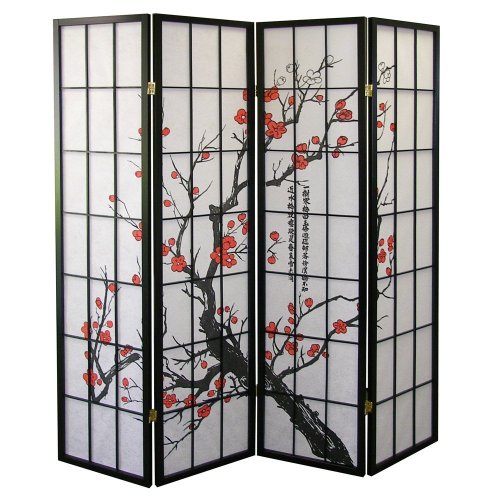
A shoji-style screen with a black wood frame and white rice paper panels printed with a red-and-black plum blossom design.
Best for: a quiet reading nook where a Japanese screen fits the room Skip it if: you need more than 71 in of width from a single unit
This is the most expensive pick in the set and the smallest by opened footprint. Four 18 in panels give a total width of 71 in at 71 in tall, so it forms a near-square when fully opened. The frame is wood in a black finish, and the panels are white rice paper printed with a red-and-black plum branch. The listing notes each panel is roughly 18 in wide and the full opened dimensions are approximately 71 in by 71 in. At 11 lb it is the lightest freestanding screen here by a clear margin.
The trade is direct: you pay the premium price for a piece of decor, not for privacy coverage. Against the natural Shoji, this version adds pattern and a darker frame but gives up 1 in of overall width. Against the VEVOR, it loses 65.4 in of coverage and costs more. If the room already has a design language and the divider is meant to belong to it, this is the pick. If the job is functional splitting of a bedroom or studio, the VEVOR does more for less.
Pros:
- Lightest freestanding screen here at 11 lb
- Wood frame in black finish
- Rice paper with plum branch print
- Ready to use, no assembly
- Folds flat for storage
Cons:
- Most expensive of the six
- Only 71 in of opened width
- Rice paper vulnerable to damage
- Only one seller lists it
Freestanding panels or a tension-rod curtain?
There are two mechanisms in this shortlist and the choice between them is bigger than the choice between brands.
Freestanding folding screens stand on their own feet. Five of the six picks here work this way. They need floor space in a zigzag to stay upright, so a screen that opens to 200 in of length rarely spans 200 in of straight distance in a room. You lose 10 to 20 percent of the opened width to the angle needed for stability. In return, you get an object you can move in one trip, fold flat against a wall, and take with you when you move house.
Tension-rod dividers, like the SUNALLY, brace between floor and ceiling. That gives you a true floor-to-ceiling split with no floor footprint, which no folding screen can match. The catch is threefold: you need a ceiling the rod can push against, you need to supply the curtain, and you need to accept that the divider is soft. A fabric curtain hides a sightline. It does not stop a bumped shoulder.
How much wall are you really trying to cover?
Panel count and width are the two numbers most buyers misread. Here is the arithmetic that decides it.
- Bedroom corner or dressing area: 60 to 80 in of coverage. The Plum Blossom Roundhill (71 in) and the natural Shoji Roundhill (68 in) fit here.
- Studio split, workspace behind a bed: 100 to 140 in. The VEVOR (136.4 in) and the MAYOLIAH (120 in) fit here.
- Classroom, wide living room, event backdrop: 160 in and up. Only the Grezone (200 in) fits here.
- Rental where you cannot leave a footprint: the SUNALLY tension rod, 28 to 70 in wide with your own curtain.
Two things to remember. First, none of these figures survive a straight line: fold each screen into a shallow zigzag and expect to lose roughly one panel's width of straight-line coverage. Second, height is fixed at 71 to 72.4 in on every folding pick. If you want to block sightlines above 6 ft, only the tension rod reaches.
What the listings do not tell you about stability
Every freestanding screen here relies on the same thing to stay upright: the angle between its panels. The listings do not spell that out, but the MAYOLIAH bullet mentions it directly, recommending you set it up with angles rather than flat. The rest imply it by showing zigzag photos and never straight ones.
That has practical consequences. A screen opened flush against a wall is unstable, because the panels want to fold. A screen opened into a gentle Z or W shape is stable, because each fold braces the next. On carpet, a heavier frame like the MAYOLIAH's 22.6 lb iron or the VEVOR's 21.4 lb build sinks in slightly and stays put. On hardwood, the same screens slide more easily if bumped, and a lighter pick like the 11 lb Plum Blossom Roundhill can tip if a pet or a child pushes a single panel.
If the room has smooth floors and any risk of bumps, weight is your friend and so is panel count. Six panels give more folds, and more folds mean more stability. Four panels look neater but rely on a deeper angle to stay up.
Which style suits which room?
The six picks split cleanly into three visual families, and the room usually chooses for you.
- Utility, fabric-panel screens. The VEVOR is the only pick in this family here. Grey Oxford fabric over a hidden frame reads as neutral and disappears in a home office or a bedroom, which is often what you want when the divider is not meant to be looked at.
- Iron-frame work screens. The Grezone and MAYOLIAH share this look: black powder-coated frames with fabric infill, six panels each. They read as functional rather than decorative, and they suit garages, classrooms, home gyms and family rooms where the divider is used daily.
- Japanese-style shoji screens. The two Roundhill picks fit here. Wood frames, rice paper panels, either natural or black-and-red. They read as furniture, and they work in a living room or a bedroom where the divider is part of the decor, not hidden.
The SUNALLY sits outside all three because it is a mechanism, not a screen. Whichever curtain you hang decides what visual family it belongs to.
The verdict
Two picks split the field.
If the room needs a solid, opaque split of 100 to 140 in of width at standing height, the VEVOR Room Divider is the right default. It gives you 136.4 in of coverage at 72.4 in tall on an Oxford-fabric build, and it sits at the second-cheapest position in this set. That combination of width, height and price does not repeat elsewhere in the shortlist.
If the room needs a genuine floor-to-ceiling split and you cannot leave a footprint or drill a wall, the SUNALLY Room Divider Curtain Rod wins on the mechanism alone. Adjustable from 4 to 10 ft tall and 28 to 70 in wide, cheapest of the six, no tools required. Bring your own curtain and you have a real divider in the one situation the folding screens cannot handle.
The cutoff is the ceiling. Below 8 ft of blocked sightline, the VEVOR is enough. At full room height, only the SUNALLY reaches. Everything else in this set is a specialisation of one of those two ideas: the Roundhills lean decorative, the MAYOLIAH and Grezone lean wide and hard-wearing, and the price gap between them reflects trim, not function.
FAQ
How tall are the best room dividers here?
The best room dividers in freestanding form all stand between 71 in and 72.4 in tall. The VEVOR leads at 72.4 in. Both Roundhill screens and the MAYOLIAH and Grezone six-panel picks sit at 71 in. Only the SUNALLY tension rod exceeds that, adjusting from 4 ft to 10 ft in height to reach a full ceiling.
Is a six-panel room divider worth it over a four-panel?
A six-panel divider is worth it when width matters. The Grezone opens to 200 in and the MAYOLIAH to 120 in, compared with 136.4 in from the four-panel VEVOR and 68 to 71 in from the two Roundhill four-panels. More panels also mean more folds, which means more stability. If you only need to cover 6 ft, four panels are lighter and easier to move.
VEVOR vs SUNALLY: which room divider should I pick?
VEVOR vs SUNALLY comes down to whether you want the divider to block sightlines by itself or provide a mechanism. The VEVOR is a solid Oxford-fabric folding screen, 136.4 in wide and 72.4 in tall, ready to use out of the box. The SUNALLY is a stainless-steel tension rod, 4 to 10 ft tall, that needs a curtain you supply. Renters usually want the SUNALLY. Owners usually want the VEVOR.
Do room dividers actually block sound?
Room dividers do not block meaningful sound. Every pick here is designed for sightline privacy, not acoustic isolation. Oxford fabric, rice paper and powder-coated iron frames all let sound pass through with only a slight muffling effect. If you need real sound reduction, a divider is the wrong tool: look at heavy curtains, acoustic panels or a bookshelf full of books instead.
What is the biggest mistake buyers make with room dividers?
The biggest mistake is buying by panel count rather than opened width. A six-panel screen sounds impressive, but the MAYOLIAH at six panels opens to 120 in while the four-panel VEVOR opens to 136.4 in. Measure the wall or gap you want to cover, then match a divider whose opened width exceeds it by 15 to 20 percent to allow for the zigzag stability angle.
Measure the space first, then decide between a folding screen and a tension rod. If the number you write down is between 100 and 140 in and the ceiling is 8 ft, the VEVOR handles it at 72.4 in tall on the widest coverage in this set under an entry price. If you rent, the SUNALLY is the only pick that avoids a floor footprint and reaches the ceiling. Everything else in the shortlist trades width for style, warranty or weight, and those trades are worth making only once the two structural questions are answered.