Best Small Standing Desk for Writers: Top Picks

A ranked look at five compact sit-stand desks, matched to the way writers actually work: long drafting sessions, tight rooms, and one laptop on the surface.

By Jadiel FranklinUpdated 15 min read
On this page
- Best small standing desk for writers at a glance
- How I cut the list down to five
- The 30-second shortlist by writing setup
- 1. COMHOMA CO-DH004 — Best overall
- 2. FEZIBO 48 x 24 in Electric — Best for quiet operation
- 3. NEXT BEAUTY HTK-4540 — Best upgrade
- 4. ErGear EGESD5B — Best premium
- 5. DUMOS Rolling Desk — Best minimal setup
- Manual, pneumatic or electric: which lift suits a writer?
- How small is small enough for a one-laptop desk?
- What the listings do not tell you about writing at standing height
- COMHOMA vs FEZIBO: which wins for daily drafting?
- The verdict
- FAQ
The best small standing desk for writers is the COMHOMA CO-DH004, because at 31.5 x 15.75 in it fits a laptop, a notebook and a mug on lockable casters, and lifts to 45.86 in for tall drafters. If you want a quieter electric lift on a larger 48 x 24 in surface, the FEZIBO takes it, with a claimed noise level under 45dB.
Most guides to the best small standing desk for writers rank on motor power and load capacity. Those matter for a monitor stack, not a writing surface. What actually decides this category is the tabletop footprint against your room, and the lift type against your working habits.
Best small standing desk for writers at a glance
| Pick | Tabletop | Lift type | Price |
|---|---|---|---|
Best overall COMHOMA CO-DH004 |
31.5 x 15.75 in | 4-level manual 28.14–45.86 in |
Check Price |
Best for quiet operation FEZIBO 48 x 24 in Electric |
48 x 24 in | Electric 28.3–46.5 in |
Check Price |
Best upgrade NEXT BEAUTY HTK-4540 |
45.7 x 23.6 in | Electric 28–46 in |
Check Price |
Best premium ErGear EGESD5B |
48 x 24 in | Electric with presets | Check Price |
Best minimal setup DUMOS Rolling Desk |
42.5 x 19 in | Pneumatic 28.54–42.52 in |
Check Price |


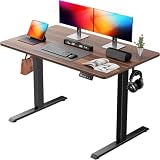

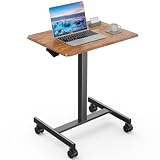
How I cut the list down to five
I started from listings tagged as small standing desks and worked through the published specifications side by side. Three cuts did most of the work.
- Footprint over 48 in wide was out. A writer with a shared room or a rental corner will not clear a full 60 in span. That kept the surface honest for the keyword.
- No published height range was out. A sit-stand desk that will not tell you where it tops out is a desk you cannot match to your elbows. Every pick here publishes a range in inches.
- No published weight or dimensions was out. A writer wants to know if the surface will hold a laptop, a lamp, and a stack of books without a wobble at 45 in.
That reduced the field to five. One is manual with four preset heights and casters. Three are electric with memory presets. One is pneumatic with a lever. That spread of lift types is deliberate, because the right lift for a writer depends less on price than on how often you switch positions and how quiet the room needs to be.
None of these desks was designed specifically for writers, so treat the qualifier as a shopping consideration you apply yourself: the surface has to hold a laptop and a notebook side by side, and the lift has to be quiet enough not to break a sentence.
The 30-second shortlist by writing setup
Writers do not all work the same way. Here is the map.
- One laptop, tight room, budget first: COMHOMA CO-DH004. It is the cheapest of the five and the smallest tabletop at 31.5 x 15.75 in.
- Shared room, electric lift, quiet is the priority: FEZIBO. Its listing claims noise levels under 45dB during operation.
- Wood finish, memory presets, mid-price: NEXT BEAUTY HTK-4540 in Dark Walnut, with two memory presets and an anti-collision stop.
- Permanent desk, monitor arm, room to spread out: ErGear EGESD5B. It is the heaviest of the five at 43.8 lb, which is a proxy for a stiffer frame.
- No motor, no cord, no learning curve: DUMOS. Pneumatic lift, four silent wheels, 42.5 x 19 in surface.
The cutoff between the small manual desks and the full electric ones is roughly 20 lb. Below that, you are buying something you can lift by yourself. Above that, the desk lives where you build it.
1. COMHOMA CO-DH004 — Best overall
A 31.5-inch rolling tabletop with a lockable drawer, four preset heights and casters, at the cheapest position in this set.
Best for: a writer working from a bedroom or dorm with almost no floor space. Skip it if: you plan to run dual monitors or a full mechanical keyboard tray.
The CO-DH004 is the only pick in the set built around a small footprint rather than a shrunk-down office desk. The tabletop is 31.5 x 15.75 in, which is roughly the size of a laptop plus a paperback beside it. That is enough for a drafting session. It is not enough for two screens and a document stack, and pretending otherwise would set you up for a return.
Height runs across four fixed steps from 28.14 in to 45.86 in, which is the tallest maximum in the set. Tall writers get to stand at a real elbow angle without a stack of books under the laptop. The whole desk weighs 6.7 lb, so you lift it into position with one hand. Four lockable casters mean it rolls out of the way when you want the room back, and COMHOMA calls out a metal frame with cross triangular bracing for stability.
The trade-off is honest. There is no motor and no memory: you change height by hand, four positions only, and you commit to one for the session.
Pros:
- Smallest tabletop in the set at 31.5 x 15.75 in
- Cheapest of the five
- Extra-tall reach at 45.86 in
- Lockable casters and a built-in storage drawer
- Only 6.7 lb, easy to move
Cons:
- Manual four-step height, no fine adjustment
- No memory presets
- Surface too narrow for dual monitors
2. FEZIBO 48 x 24 in Electric — Best for quiet operation
A full-size electric standing desk with a claimed sub-45dB motor and three memory presets, in a maple finish.

Best for: a writer sharing a room and running an electric lift near a partner or child. Skip it if: you need to roll the desk out of the way between sessions.
The FEZIBO is the pick for anyone who has ever had a motorised desk drown out a sentence. FEZIBO says the lift runs at under 45dB and is tested for 50,000 lift cycles. Attribute those numbers to the manufacturer, not to a measurement I made, but they are the clearest quiet-operation claim in this set.
The surface is 48 x 24 in, which is where a small standing desk stops being small. That said, it is still the shallowest depth you can reasonably fit a laptop and a monitor on in a line. Height range is 28.3 in to 46.5 in with three memory presets, and FEZIBO rates the load at 176 lb, the highest published figure in this comparison. The desktop is FSC-certified wood in a maple tone, which sits better in a bedroom than the usual black particleboard.
The compromise is mobility. Once assembled, this desk stays where you built it. It is also the fourth-most expensive pick, and it sells at a mid-pack rate compared with the ErGear and the COMHOMA.
Pros:
- Manufacturer claim of under 45dB motor noise
- Three memory presets
- 176 lb rated load, the highest published here
- Maple FSC-certified desktop
- 28.3 in to 46.5 in range
Cons:
- Cannot be rolled between rooms
- 48 in width dominates a small room
- Assembly is required, listing says about 30 minutes
3. NEXT BEAUTY HTK-4540 — Best upgrade
A dark walnut electric desk with two memory presets, anti-collision, and a slightly narrower 45.7 in top.

Best for: a writer who wants memory presets and a warmer wood finish. Skip it if: you want the widest published weight capacity in the set.
The HTK-4540 sits between the FEZIBO and the ErGear on price and behaves as a middle path in features. NEXT BEAUTY lists the height range at 28 in to 46 in and the load capacity at a real-tested 132 lb. That is the lowest of the three electric desks here, and it matters if you plan to load a heavy monitor and a document camera on the surface. For a laptop, a notebook and a coffee, it is not the constraint.
Two things earn it the upgrade slot. First, the Dark Walnut finish is the only one in this set that reads as furniture rather than office kit, and for a writer who works in the living room, that is not a small thing. Second, the listing calls out anti-collision that stops and reverses within about an inch of an obstruction, which is the kind of feature that saves a lamp during a hurried lift.
The weakness is set-relative. It sells more slowly than the FEZIBO and the ErGear in this set, and its published load falls short of both.
Pros:
- Dark Walnut furniture-grade finish
- Two memory presets
- Anti-collision auto-stop
- 28 in to 46 in electric range
- Sub-50dB claimed noise level
Cons:
- Lowest published capacity of the three electric picks at 132 lb
- Only two presets, not three
- Slowest seller in this set
4. ErGear EGESD5B — Best premium
The heaviest and most expensive pick, built around an alloy steel frame and low-VOC materials.

Best for: a writer building a permanent desk that will hold a monitor arm and reference stack. Skip it if: the desk has to move room to room.
The ErGear is the most expensive pick here and the heaviest at 43.8 lb. In desk terms, weight is largely a proxy for frame stiffness. ErGear names aerospace-grade lifting columns and a heavy-duty alloy steel frame, and offers the widest distribution in this set at three sellers. It sells faster than the rest of the picks here too, so the frame reputation is earning its keep.
The tabletop is 48 x 24 in in black. That is not a compact footprint by the small-desk definition, but if you have a corner or an alcove that will take it, this is the desk that will not shift when you clamp a monitor arm to the back edge. ErGear also calls out low-VOC materials, which the other listings do not mention, and matters if you write for eight hours a day in a closed room.
The compromises are size and mobility. It is the same 48 in span as the FEZIBO, without the maple finish and without the quiet-motor claim.
Pros:
- Alloy steel frame and named aerospace-grade columns
- Low-VOC materials called out by the manufacturer
- Widest seller distribution in this set at three sellers
- Memory presets on the controller
- Fastest seller in this five-desk lineup
Cons:
- Highest price position in the set
- 43.8 lb, not portable once built
- Black finish, less warm than walnut or maple
5. DUMOS Rolling Desk — Best minimal setup
A pneumatic sit-stand desk on four silent wheels, no motor, no cord, no memory.
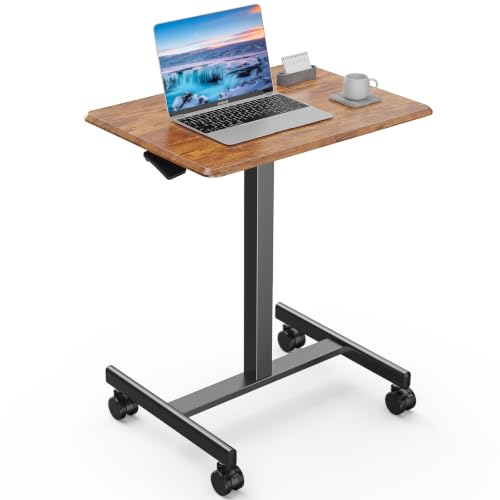
Best for: a writer who wants a pneumatic lift with no motor and no cord. Skip it if: you want programmable memory positions.
The DUMOS is the odd desk out in this set, and that is why it is here. It lifts by pneumatic lever between 28.54 in and 42.52 in, so height is continuous rather than stepped, and there is no motor to make noise or fail. The tabletop is 42.5 x 19 in in a modern brown finish, and the whole thing weighs 23.8 lb. Four silent wheels are lockable, so it rolls into a corner when you are done.
For a writer, the pitch is simple: nothing to plug in and nothing to program. You grip the lever, you lift the surface to elbow height, you write. It is the second-cheapest pick in the set.
Two things to know before buying. First, the top height is 42.52 in, which is the lowest maximum in this comparison, so tall writers should check the reach against their elbows. Second, a pneumatic lift is a one-hand operation but not a hands-free one: there are no presets, and every position change is manual.
Pros:
- Pneumatic lift, no motor, no cord
- Continuous height between 28.54 and 42.52 in
- Four silent lockable wheels
- 42.5 x 19 in top fits a laptop and a notebook
- Second-cheapest pick here
Cons:
- No memory presets
- Lowest maximum height at 42.52 in
- Sells more slowly than the electric picks in this set
Manual, pneumatic or electric: which lift suits a writer?
Writers switch position less often than programmers or designers, because a paragraph is a longer unit than a bug fix. That tilts the lift-type math.
- Manual four-step, like the COMHOMA. Best when you pick a standing height in the morning and a sitting height after lunch. Two changes a day. No motor to fail, and 6.7 lb of desk to move.
- Pneumatic, like the DUMOS. Best when you want continuous adjustment but no cord. A lever change takes a second, so mid-session changes are realistic.
- Electric with memory, like the FEZIBO, NEXT BEAUTY and ErGear. Best when you actually switch four or more times a day, or when you share the desk with someone at a different height. Presets earn their keep at that frequency.
There is one honest catch with electric desks in a writing room. Even a quiet motor is a sound, and a sound during a sentence is a sentence lost. Both the FEZIBO and the NEXT BEAUTY listings call out sub-45dB and sub-50dB numbers respectively. Attribute those to the manufacturer and expect audible operation, especially in a small carpeted room.
How small is small enough for a one-laptop desk?
Here is the trick with small standing desks: the width you see in the listing is not the width you get to use, because your keyboard needs a hand span on each side.
Working backwards from a 13 in laptop plus a paperback notebook to the right of it, you need roughly 24 in of usable width. Add 4 in of cable and edge margin, and 28 in is the practical minimum. The COMHOMA's 31.5 in top gives you a hand of clearance beyond that. The DUMOS at 42.5 in leaves room for a lamp. The three 48 in desks are larger than a small writing desk needs to be, and they are here because they add features, not because they add usable writing space.
Depth matters more than most buyers realise. At 15.75 in, the COMHOMA is shallow enough that a laptop screen sits close to your face, which is fine for a writer working in a single window, but tight for a reference-plus-drafting setup. The 24 in depth on the FEZIBO and ErGear is the standard for a reason: it fits a laptop with a notebook in front of the keyboard.
What the listings do not tell you about writing at standing height
Three things you have to judge for yourself.
- Your elbow height, not your total height. Standing desks are usually specified against user height, but elbow height is what actually matters. A writer with long arms and a short torso wants a lower maximum than the listing would suggest.
- The floor under the desk. A rolling desk on a soft carpet with underlay will feel less stable than the same desk on hard floor. All four wheeled and pneumatic picks here are specified for hard surfaces first.
- Cable routing during a lift. An electric desk rising from 28 in to 46 in pulls 18 in of cable up with it. None of these listings mention a cable tray, so plan on Velcro straps and a coiled charger.
In practice, most writers using a small standing desk stand for 40 to 90 minutes at a stretch, then sit. That is a workload every one of these desks handles, but it is a workload the wrong height range makes miserable.
COMHOMA vs FEZIBO: which wins for daily drafting?
These are the two most cross-shopped picks in the set, and they sit at opposite ends of the trade.
Pick the COMHOMA if:
- Your room is under 100 sq ft and shared with a bed
- You want to move the desk out of the way at night
- Your budget is the entry position in this set
- You will change height twice a day at most
Pick the FEZIBO if:
- You have a permanent corner for a 48 in desk
- You want an electric lift with memory presets
- You will run a monitor as well as a laptop
- Noise matters because you write near someone else
The cutoff is not price. It is whether the desk moves. If it moves, take the COMHOMA. If it stays, take the FEZIBO.
The verdict
The best small standing desk for writers is the COMHOMA CO-DH004. It wins because it is the only pick in this set that treats "small" as the brief rather than the constraint. The 31.5 x 15.75 in tabletop is sized for a laptop and a notebook, the 6.7 lb frame moves with one hand, and the 45.86 in top height clears elbows for taller writers. Four preset heights and lockable casters cover the drafting-day workload without a motor or a memory chip to fail.
If you have a permanent corner and share the room with someone whose sleep matters, the FEZIBO is the better buy: the sub-45dB manufacturer claim, three memory presets and 176 lb rated load buy you a full electric setup on a maple top. Writers building a long-term studio with a monitor arm and reference gear should skip both and take the ErGear EGESD5B, which is the heaviest and stiffest frame in this set at 43.8 lb, distributed by three sellers, and specified with low-VOC materials.
Everything else in this comparison is a valid trade against one of those three defaults.
FAQ
Is a small standing desk worth it for a writer?
A small standing desk is worth it for a writer who spends four or more hours a day drafting and who currently uses a chair-and-table setup that pins them to one height. The cheapest pick here, the COMHOMA CO-DH004, adds four working heights from 28.14 in to 45.86 in and rolls out of the way after. Below four hours a day, a laptop riser will do the same job.
What is the minimum desk width for a writer's laptop and notebook?
The minimum desk width for a writer's laptop and notebook is roughly 28 in, based on a 13 in laptop plus 8 in of notebook and 7 in of hand and cable margin. The COMHOMA at 31.5 in and the DUMOS at 42.5 in both clear that bar. The three 48 x 24 in desks leave room for a monitor, but they stop being small at that width.
How quiet is a quiet electric standing desk?
A quiet electric standing desk in this set is claimed at under 45dB in the FEZIBO listing and under 50dB in the NEXT BEAUTY listing. Attribute those figures to the manufacturers rather than to measured tests. In practice, both are audible in a silent room during a lift, so most writers program the presets and change height between paragraphs, not mid-sentence.
COMHOMA vs DUMOS: which is better for a small room?
COMHOMA vs DUMOS for a small room comes down to how you switch height. The COMHOMA is smaller at 31.5 x 15.75 in, lighter at 6.7 lb and cheaper, but locks to four preset heights. The DUMOS is larger at 42.5 x 19 in, heavier at 23.8 lb, and lifts pneumatically to any point between 28.54 in and 42.52 in. Pick the COMHOMA for footprint, the DUMOS for continuous adjustment.
What is the biggest mistake buying a first standing desk?
The biggest mistake buying a first standing desk is choosing on motor power instead of surface size. A powerful lift on a top too shallow for your laptop and notebook is a desk you will not use. Measure your working span first: laptop width plus notebook width plus 4 in of margin. Then match a desk from this set to that number, and only then compare lift type and price.
Small standing desks are not miniature office desks, and the ones that get used are the ones sized honestly for a single writing task. Start by measuring the corner or wall where the desk will live, then measure your elbow height with your shoulders relaxed. Those two numbers eliminate most of the field before price enters the conversation. The COMHOMA CO-DH004 wins here because it treats a tight room and a single laptop as the whole design brief, not a constraint bolted onto a bigger desk. If your room and your workload are bigger than that, the FEZIBO and the ErGear are the honest steps up.