Best Solid Wood Room Divider for Kids' Rooms

Seven solid wood room dividers ranked for kids' rooms, from an 11 lb budget folder to a 48.3 lb hand-carved screen, with the trade-offs named.

By Jadiel FranklinUpdated 17 min read
On this page
- Best solid wood room divider for kids at a glance
- How I screened the field down to seven
- 1. COTTON CRAFT Room Divider Wood Screen — Best overall
- 2. GIANTEX 3 Panel Folding Wooden Room Divider 67" Tall — Runner-up
- 3. Cozy Castle 4 Panel Folding Room Divider — Best minimal setup
- 4. FDW 4-Panel Folding Room Divider — Best budget pick
- 5. ALeesing 4 Panel Solid Wood Room Divider — Best for small spaces
- 6. Furnnylane 5 Panel Bamboo Room Divider — Best for beginners
- 7. Roundhill Furniture Oriental Shoji 4 Panel Screen Room Divider — Best for pros
- Does 'solid wood' really mean kid-safe?
- How tall a divider does a shared kids' room actually need?
- Weight, tip risk and the anti-tip kit question
- What each price tier actually buys
- The verdict
- FAQ
The best solid wood room divider for kids is the COTTON CRAFT Room Divider Wood Screen, a 4-panel 72 x 80 in hand-carved piece that weighs 48.3 lb and stays where you put it. If you'd rather have a lighter, ready-to-place option with a built-in anti-tip kit, the GIANTEX 3 Panel Folding Wooden Room Divider at 67 in tall is the smarter pick for a small shared bedroom.
Here's the thing most parents comparing dividers get wrong: they shop by panel count. Panel count barely matters. What decides a kids' room divider is the ratio of weight to footprint, whether it has an anti-tip system, and how tall the panels are relative to your child's line of sight.
Best solid wood room divider for kids at a glance
| Pick | Height | Weight | Price |
|---|---|---|---|
Best overall COTTON CRAFT Room Divider Wood Screen |
80 in | 48.3 lb | Check Price |
| 67 in | 28 lb | Check Price | |
Best minimal setup Cozy Castle 4 Panel Folding Room Divider |
63 in | 26.5 lb | Check Price |
Best budget pick FDW 4-Panel Folding Room Divider |
70 in | 11 lb | Check Price |
Best for small spaces ALeesing 4 Panel Solid Wood Room Divider |
67 in | not listed | Check Price |
Best for beginners Furnnylane 5 Panel Bamboo Room Divider |
67 in | not listed | Check Price |
Best for pros Roundhill Furniture Oriental Shoji 4 Panel Screen |
72 in | 15 lb | Check Price |



How I screened the field down to seven
I set weights on the criteria before I looked at the listings, then applied them.
- Frame material. The keyword is a solid wood room divider for kids, so any pick built primarily on plastic or metal was out. The Furnnylane uses bamboo panels with a pinewood frame, which is the closest bamboo option and earned its place on that basis.
- Sight-line height. A divider under 60 in doesn't hide a top bunk or a standing sibling. Every survivor here reaches at least 63 in, and four of the seven clear 67 in.
- Stability signals. Anti-tip kit, non-slip base mats, or enough weight to resist a shove. Only one listing, the GIANTEX, explicitly includes an anti-tip kit.
- Assembly burden. For a kids' room, "unfold and place" beats "unbox and build". Five of these ship ready to use.
What got cut before the shortlist: printed fabric screens that call themselves wood because of the frame, mesh dividers, and anything shorter than 60 in. The seven that survived cover four panels in five cases, three in one, and five in one, at heights from 63 in to 80 in.
1. COTTON CRAFT Room Divider Wood Screen — Best overall
A hand-carved 72 x 80 in screen whose 48.3 lb heft is the whole point in a kids' room.
Best for: a shared kids' room that doubles as a guest space Skip it if: you need to move the screen often
This is the tallest and heaviest divider in the set, and both numbers work in your favour with children. At 80 in it hides a top bunk from the door, and at 48.3 lb it doesn't scoot when a kid brushes past. COTTON CRAFT lists the frame as solid wood with hand-carved panels on MDF, which is the standard construction for screens at this weight class. The Rajasthan antique brown finish is decorative rather than nursery-cute, so it survives the transition from toddler room to tween room to spare room. Fully extended, it covers 80 in of floor line across four 20-inch panels.
The trade-off is real: this is the most expensive pick here and the heaviest by more than 20 lb. If you plan to fold and stow the divider weekly, look further down the list. If it's staying put for months at a time, the weight is doing the job the lighter picks can't.
Pros:
- Tallest panels here at 80 in
- Heaviest in the set at 48.3 lb, so hard to knock over
- Fully reversible carved panels
- Decorative finish that outlasts a kids' phase
- Four panels for wide coverage
Cons:
- The most expensive pick here
- Panels are carved MDF, not solid hardwood faces
- No published anti-tip hardware
- Heavy to reposition alone
2. GIANTEX 3 Panel Folding Wooden Room Divider 67" Tall — Runner-up
The only pick in the set that explicitly ships with an anti-tip kit, and that alone earns it second place.

Best for: a narrow zone in a small bedroom, thanks to the included anti-tip kit Skip it if: you need a fourth panel for full coverage
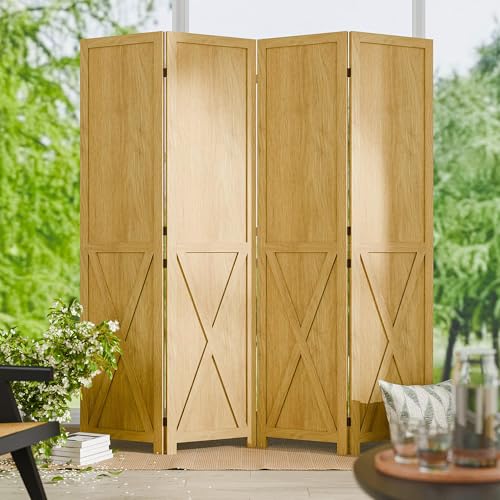
Three panels instead of four, 67 in tall, 28 lb, and rubberwood throughout. GIANTEX says the panels are premium rubberwood with a rustic finish, and the listing states no assembly is required. What matters most for a kids' room is the last line of the feature copy: an anti-tip kit is included. None of the other six picks names one. In a room where a five-year-old might grab the top edge to peek round, that's the specification I'd pay for.
The three-panel format expands to 53 in of coverage, versus 63 to 80 in on the four- and five-panel options. So this is the divider for splitting a corner or a bed nook, not for cutting a full room in half. Against the COTTON CRAFT it loses on height and weight, but the anti-tip hardware and lower price position make it the smarter first buy for parents who have not lived with a divider before.
Pros:
- Only pick with an anti-tip kit named in the listing
- Rubberwood build, ready out of the box
- 28 lb keeps it stable but portable
- Natural wood grain suits any room palette
- Second-cheapest solid wood pick here
Cons:
- Three panels cover only 53 in
- Shorter than the top overall pick by 13 in
- Rustic finish may not suit modern decor
- No hinged privacy at the wall edges
3. Cozy Castle 4 Panel Folding Room Divider — Best minimal setup
A 63 in natural-wood folder with stainless steel hinges, aimed at parents who want zero chemical smell.
Best for: parents who want a chemical-free frame and no assembly Skip it if: you want a printed or carved decorative face
Cozy Castle says the frame is 100% natural solid wood with no harmful chemicals, glues, or toxic finishes, and that the reinforced stainless steel hinges keep it wobble-free. At 26.5 lb across four panels and 69.9 x 63 in overall, it's roughly mid-range for weight in this set and mid-range for price. The slatted natural face is the plainest look here, which is actually useful in a nursery you plan to redecorate every couple of years: nothing about it says "toddler".
Two honest weaknesses. First, at 63 in it's the shortest of the seven, so a standing adult sees over it. That's usually fine for splitting cribs from play areas but not for hiding a top bunk. Second, the same slatted design that keeps it airy also means sight lines pass through the gaps, so it divides space rather than blocking it. Against the COTTON CRAFT it saves weight and money; against the GIANTEX it adds a fourth panel and 10 in of width.
Pros:
- Manufacturer claims a chemical-free build
- Stainless steel hinges named in the listing
- Fully assembled, folds flat
- Four panels across 63 in of width
- Neutral natural finish
Cons:
- Shortest divider here at 63 in
- Slatted face doesn't block sight lines fully
- No anti-tip hardware listed
- Plain look won't excite kids
4. FDW 4-Panel Folding Room Divider — Best budget pick
The cheapest of the seven and the lightest at 11 lb, which is both the appeal and the warning.

Best for: a temporary split you'll fold away every few weeks Skip it if: your child leans on furniture for balance
FDW lists the divider at 70 in tall, coal black, four panels, and 11 lb. That's less than a quarter of the COTTON CRAFT's weight, and less than half of the Cozy Castle. The upside is that a parent can carry it under one arm and reposition it in seconds; the listing calls out the folding, portable format. The downside is that anything a toddler can pull on will come down easily. There's no anti-tip kit in the listing.
Read this pick as the right buy for older kids or a short-term arrangement: a guest bunk during the school holidays, a video-call corner during exam week, a zone for a birthday sleepover. The coal black finish hides scuffs and fingerprints, which is a nice unstated advantage over the pale natural finishes elsewhere in the set. The trade-off against every other pick here is stability. You gain portability and price; you lose the peace of mind a heavier or anti-tipped divider gives you.
Pros:
- The cheapest pick in this set
- Lightest at 11 lb, so easy to move
- 70 in of height, taller than four rivals
- Dark finish hides marks
- Two sellers list it, so easier to source
Cons:
- 11 lb is easy for a child to knock over
- No anti-tip hardware named
- Panels are only 17 in wide each
- Less premium feel than the wood-grain picks
5. ALeesing 4 Panel Solid Wood Room Divider — Best for small spaces
A four-panel white screen at 67 x 15.7 in per panel, sized for narrow footprints.

Best for: narrow nurseries and reading nooks under 6 ft wide Skip it if: you need floor-to-ceiling privacy
ALeesing lists solid wood construction, a white finish, four panels, and 67 in of height. Per-panel width is 15.7 in, which is the narrowest of the four-panel options here and the reason it earns the small-spaces award: at full extension it covers a shorter run of floor than the Cozy Castle or the COTTON CRAFT, so it fits into rooms where the wider dividers wouldn't unfold cleanly. White also bounces light in a way the darker picks don't, which matters in a small kids' room without a window.
Weight isn't listed, so I can't tell you how it compares to the 26.5 lb Cozy Castle or the 11 lb FDW. That's a real gap in the data and the reason it doesn't rank higher: I can guess it sits between them from the size, but I won't. The listing says it arrives fully assembled and can double as a window sun-block or a decorative background. Against the rest of the set it wins on footprint and finish, and loses on transparency of specifications.
Pros:
- Narrowest four-panel footprint here
- Bright white finish suits small rooms
- Fully assembled out of the box
- Manufacturer claims solid wood build
- Doubles as a sun-block or backdrop
Cons:
- No weight figure published
- Slowest seller in this set
- No anti-tip kit named
- White paint scuffs show on a kids' divider
6. Furnnylane 5 Panel Bamboo Room Divider — Best for beginners
Five bamboo panels across 76.75 in of width, with a hand-sanded pinewood frame and non-slip base mats.

Best for: first-time buyers who want it ready out of the box Skip it if: you specifically want hardwood, not bamboo
Furnnylane says the frame is hand-sanded solid pinewood with reinforced hinges and non-slip base mats, and the panels themselves are bamboo. That's a legitimate choice for a kids' room: bamboo is dimensionally stable and holds up well in humidity, useful if the room shares a wall with a bathroom. The five-panel W-fold expands to 76.75 in of coverage, more than any other pick here except the COTTON CRAFT's 80 in. The listing calls out chemical-free materials, no synthetic paints, no adhesives.
The catch is that "solid wood" purists will note the panels are bamboo rather than a hardwood species. If that distinction matters to you, the Cozy Castle or the GIANTEX is closer to what you're picturing. If you just want a stable, ready-to-place, safe-materials divider that covers 6 ft of floor, this is the beginner-friendly option: no assembly, non-slip mats already fitted, and a W-fold that stands without leaning against anything.
Pros:
- Five panels cover 76.75 in
- Non-slip base mats included
- Manufacturer claims chemical-free materials
- Hand-sanded pinewood frame
- Two sellers list it
Cons:
- Bamboo, not hardwood
- No weight figure published
- The second-most expensive pick here
- No anti-tip kit named
7. Roundhill Furniture Oriental Shoji 4 Panel Screen Room Divider — Best for pros
A 72 in shoji-style screen with rice-paper panels on a light wood frame, best in hands that know what they're buying.

Best for: parents comfortable with a rice-paper screen and a light frame Skip it if: your kids are toddlers or ball-throwers
Roundhill lists the frame as wood in a natural finish, with fiberglass-like heavy-duty rice-paper panels, 72 in tall, 15 lb, and 17 in per panel. In a kids' room this is the pick with the most caveats. The paper panels are the whole aesthetic and also the whole vulnerability: they translate light beautifully and they tear if a toddler puts a finger through them. The 15 lb weight is the second-lightest in the set, so it'll move if leaned on.
Why include it at all? Because for the right kid, an older child who wants a room that looks intentional and doesn't share it with a sibling, the shoji look is genuinely lovely and this is the only one in the set that offers it. The listing says it folds flat for storage and is ready to use instantly. Against every other pick here it loses on durability and stability. Against nothing else in the set does it win on style, and for a tween's bedroom that's the entire point.
Pros:
- Distinctive shoji look, unique in this set
- 72 in tall for good sight-line coverage
- Folds flat for storage
- Light enough to reposition at 15 lb
- Second-cheapest solid wood pick
Cons:
- Rice-paper panels tear easily
- 15 lb offers little tip resistance
- Not suitable for toddlers
- No anti-tip hardware named
Does 'solid wood' really mean kid-safe?
Solid wood is a construction claim, not a safety certification. Every divider here is described by its manufacturer as solid wood or containing solid wood elements, but that phrase covers everything from a hardwood frame with carved MDF panels to a pinewood frame with bamboo inserts. None of these listings publishes an independent safety test result, and none is marketed specifically as a children's product.
What "solid wood" does tell you is roughly this: the frame won't crack under the sideways stress a folding hinge puts on it, and the surface finish is likely to be a stain or a low-VOC coating rather than a heavy lacquer. Two of the seven listings, Cozy Castle and Furnnylane, explicitly claim chemical-free construction with no synthetic paints or glues. That's a marketing claim rather than a certification, but it's the closest signal in this data to a kid-safe finish.
The rest of the safety question is about anchoring and monitoring, not the material. Any freestanding divider can be pulled over. The GIANTEX names an anti-tip kit in its listing. For the other six, you'll need to add your own anti-tip strap or place the divider against a wall.
How tall a divider does a shared kids' room actually need?
Height is decided by what you're trying to hide and who you're hiding it from. Here's the useful breakdown across this set:
- 63 in (Cozy Castle): hides a seated adult or a crib, not a standing child over about age eight.
- 67 in (GIANTEX, ALeesing, Furnnylane): hides a standing child up to roughly age ten, blocks the direct sight line from a bed to the door.
- 70 in (FDW): hides most kids under twelve when standing next to it.
- 72 in (Roundhill): blocks a standing adult's sight line for most parents.
- 80 in (COTTON CRAFT): hides a top bunk from an adult standing in the doorway.
For a shared room with a bunk bed, aim for 72 in or taller so the child in the top bunk gets real visual privacy at bedtime. For a nursery split from a play zone, 63 to 67 in is plenty and lets you see over easily to check on the child.
Weight, tip risk and the anti-tip kit question
The single biggest safety variable in this set is weight, and the spread is enormous: 11 lb at the light end, 48.3 lb at the heavy end. Only five of the seven publish a weight at all.
Rules of thumb from the data:
- Under 20 lb, and the divider will scoot or fall if a child leans on it. The FDW at 11 lb and the Roundhill at 15 lb both sit here.
- 25 to 30 lb, and the divider is stable in normal use but still lifts easily off the floor if a child grabs a panel edge. Cozy Castle at 26.5 lb and GIANTEX at 28 lb are in this zone.
- Over 45 lb, and a small child can't move it. The COTTON CRAFT at 48.3 lb is the only pick in this class.
Only one divider in this set, the GIANTEX, includes an anti-tip kit in the box. Every other pick is a candidate for a third-party anti-tip strap, the same kind used for dressers and bookshelves. Non-slip base mats, which Furnnylane names, help against slide but not against tip. Treat weight and anti-tip hardware as independent safety layers, not substitutes.
What each price tier actually buys
The seven picks span three price bands. Here's what each buys you, described by what changes rather than by figures.
At the entry tier, you get the FDW, the Roundhill, and the GIANTEX. Between them these cover the lightest, the shortest-warranty aesthetic (shoji paper), and the only anti-tip kit in the set. The GIANTEX is the standout value here, because it's the only entry-tier pick that adds a safety feature the premium picks don't have.
At the middle tier, the Cozy Castle sits alone. What you're paying for over entry tier is a heavier build (26.5 lb versus 11 to 15 lb) and the chemical-free construction claim.
At the premium tier, you get the ALeesing, the Furnnylane, and the COTTON CRAFT. The extra outlay buys you, respectively, a narrow small-space footprint, a five-panel width with non-slip base mats, and the tallest and heaviest divider in the set. Between the three premium picks, the COTTON CRAFT is the one whose physical specifications justify the position: the other two premium picks don't publish a weight, and neither adds a safety feature that the mid-tier or entry-tier picks don't already offer.
The verdict
The COTTON CRAFT Room Divider Wood Screen is the best solid wood room divider for kids in this set because its 48.3 lb weight and 80 in height solve the two problems that actually matter: keeping the divider upright and hiding what needs to be hidden. Four hand-carved panels across 80 in of width cover a full bunk-bed elevation from doorway to wall.
Two named conditions flip the pick. First, if your child is a toddler and you cannot supervise the divider constantly, the GIANTEX 3 Panel Folding Wooden Room Divider wins on the strength of its included anti-tip kit, even though it's 13 in shorter and covers only 53 in of floor. Second, if the divider is a short-term arrangement that you'll fold and stow every few weeks, the FDW 4-Panel Folding Room Divider at 11 lb is the honest right answer: the COTTON CRAFT's 48.3 lb becomes a burden rather than a virtue.
The gap between the COTTON CRAFT and the GIANTEX is real. One is the heaviest, tallest, most decorative option. The other is the only one shipping with dedicated tip-prevention hardware. Pick by which failure mode you fear more.
FAQ
Are these dividers safe around toddlers?
Are these dividers safe around toddlers only if you add anti-tip hardware or supervise constantly. The GIANTEX is the sole pick in this set that names an anti-tip kit in its listing. Every other divider is freestanding and can be pulled over by a determined toddler. Pair any of the other six with a third-party wall strap, or place them flush against a wall the child can't climb.
Is a solid wood room divider worth it for a kids' room?
Is a solid wood room divider worth it depends on how long the setup will last. If the divider is staying up for months to give siblings visual privacy, the heavier hardwood picks like the COTTON CRAFT at 48.3 lb pay back in stability and longevity. If it's a short-term fix for a school project or a visiting cousin, the FDW at 11 lb saves money and folds away.
What height should I choose for a bunk bed?
What height should you choose for a bunk bed: at minimum 72 in, so a standing adult can't see the top bunk from the door. In this set, that means the Roundhill at 72 in or the COTTON CRAFT at 80 in. The 67 in picks and the 63 in Cozy Castle are fine for splitting a floor bed or a crib zone but leave a top bunk exposed to the doorway sight line.
COTTON CRAFT vs GIANTEX: which for a small shared room?
COTTON CRAFT vs GIANTEX comes down to whether stability or safety hardware matters more. The COTTON CRAFT wins on sheer weight (48.3 lb versus 28 lb) and covers 80 in of floor across four panels. The GIANTEX wins because it includes an anti-tip kit and asks less of your budget. For a shared room with toddlers, choose the GIANTEX. For older kids, choose the COTTON CRAFT.
What's the most common mistake buying a divider for kids?
What's the most common mistake buying a divider for kids is treating panel count as the specification that matters. It isn't. Weight, height, and anti-tip hardware decide whether the divider works and whether it stays upright. A four-panel 11 lb divider is less useful in a kids' room than a three-panel 28 lb divider with a strap. Buy the safety features first, then the panels.
If you're still torn, start by measuring the run of floor the divider needs to cover and the sight line you want to block, then match those two numbers to the table above before you look at anything else. A divider that's the wrong height for your room is a divider you'll replace within a year, regardless of how well it's made. For most shared kids' rooms with a bunk bed, the COTTON CRAFT Room Divider Wood Screen is the default because its 48.3 lb weight and 80 in height solve both problems at once, and its decorative finish outlives the phase the room is currently in.