Best Cheap Room Dividers: Rantila Leads a Six

Six folding and freestanding room dividers compared on span, weight and setup, with a named winner and the exact conditions that flip the pick.

By Jadiel FranklinUpdated 14 min read
On this page
- Best cheap room dividers at a glance
- How I screened these six dividers
- What actually decides a cheap room divider?
- 1. Rantila 2 Large Panels Room Divider — Best overall
- 2. FDW 4-Panel Folding Room Divider — Best upgrade
- 3. MAYOLIAH 6 Panel Folding Privacy Screen — Best premium
- 4. SUNALLY Room Divider Privacy Screens — Best minimal setup
- 5. Grezone Room Divider-Folding Privacy Screens — Best for pros
- 6. SUNALLY Room Divider for Separation 28-114in — Best budget pick
- Does cheap mean flimsy here?
- How wide a space can each one cover?
- When a different pick wins
- The verdict
- FAQ
The best cheap room dividers are led by the Rantila 2-panel screen, which spans 142 in wide at 16 lb and folds to split a whole room in one motion. If you want the lightest freestanding option instead, the 11 lb FDW 4-panel is the better buy. The trap with this category is span: buyers compare panel count, but two wide panels can beat four narrow ones for covering an open-plan gap. Here's how the six sort out by width, weight and how much fiddling each setup takes.
Best cheap room dividers at a glance
| Pick | Width | Weight | Price |
|---|---|---|---|
Best overall Rantila 2 Large Panels Room Divider |
142 in | 16 lb | Check Price |
Best upgrade FDW 4-Panel Folding Room Divider |
17 in per fold | 11 lb | Check Price |
Best premium MAYOLIAH 6 Panel Folding Privacy Screen |
120 in | 22.6 lb | Check Price |
Best minimal setup SUNALLY 4 Panel Divider |
88 in | not listed | Check Price |
Best for pros Grezone 4 Panel Privacy Screens |
200 in | 20.9 lb | Check Price |
Best budget pick SUNALLY Room Divider 28-114in |
28–114 in rod | 11.7 lb | Check Price |


How I screened these six dividers
I lined up the published specifications side by side and sorted them by what a small-space buyer actually judges. Two things carried the most weight: how wide the divider covers, and how heavy it is to reposition. Those two numbers rarely move together, which is where the picks separate.
Everything here sits in the folding-screen and freestanding-divider category. That mattered, because it keeps the comparison honest. A 142 in fabric screen and a 28–114 in curtain rod solve the same problem in very different ways.
Here's what I checked on each listing, in order:
- Total width, since a divider that can't reach across the gap is useless.
- Panel height, so the screen actually blocks a sightline.
- Weight, because a heavier screen is harder to move but usually steadier.
- Frame material as stated by the maker.
- Whether a warranty is published at all.
Two dividers came with a weight figure missing or a warranty absent, and I've flagged that in their sections rather than guessing. One point on the search term: "cheap" is a moving target on Amazon, and the listings don't confirm it. I've ranked on span, weight and setup, and left the number to the Check Price link.
What actually decides a cheap room divider?
Most room divider guides compare panel count. That is not what decides it. Total width is.
A four-panel screen sounds like more coverage than a two-panel one, but the Rantila's two panels stretch 142 in, while the FDW folds in 17 in segments. Panel count tells you how the screen bends, not how far it reaches. For blocking a sightline across an open-plan room, reach wins.
The second deciding figure is weight against height. A tall screen that weighs little tips easily; a heavy one stays put but fights you when you move it. The MAYOLIAH runs 22.6 lb across 120 in, so it stands firm in an L-shape. The FDW at 11 lb moves easily but needs angling to stay upright.
Three things flip the decision:
- You need to wrap a corner. Then panel count beats raw width, and a 4- or 6-panel screen wins.
- You can't drill and rent your place. Then a tension curtain rod like the SUNALLY 28–114in beats any freestanding panel.
- You reposition daily. Then the lightest screen wins, even at the cost of stability.
Read the width figure first. Everything else is secondary.
1. Rantila 2 Large Panels Room Divider — Best overall
The Rantila covers the widest single span of any freestanding panel screen here, and it does it at the second-lowest weight.
Best for: splitting a wide open-plan room in one move Skip it if: you need to bend the divider around a corner
The Rantila's number is 142 in of width at 71 in tall, carried on just 16 lb. No other freestanding screen in this set matches that reach without weighing more. Two large panels mean fewer hinges and a cleaner block, so a sightline across a studio or bedroom disappears in one stretch.
Rantila says the fabric is high-density polyethylene with a PA coating, which the listing describes as waterproof, tear-resistant and non-see-through. That is the maker's claim, not a measured result, but the material choice tracks with the low weight. The listing also states the instructions cover every step with words and pictures, measured in inches.
Its trade-off against the rest is flexibility. Two big panels don't wrap a corner the way the MAYOLIAH's six do, so the Rantila is a straight-line divider. It sits at a premium position for this set, and it's the one buyers here choose second-most often. If you want reach without heft, it leads.
Pros:
- Widest freestanding span at 142 in
- Light for its size at 16 lb
- Non-see-through fabric per the maker
- Fewer hinges for a cleaner block
- Illustrated instructions stated in inches
Cons:
- Two rigid panels can't wrap a corner
- Priced near the top of this set
- Only two sellers list it
- No published warranty
2. FDW 4-Panel Folding Room Divider — Best upgrade
The FDW is the lightest divider in the set at 11 lb, which makes it the easiest to pick up and reposition.

Best for: renters who want the lightest freestanding screen Skip it if: you need to cover more than a doorway-width gap
At 11 lb and 70 in tall, the FDW is built to move. It's the one you carry to a different corner every week without a second thought. FDW describes it as environmentally friendly wood with a simple design, and the listing says the four panels are the same size so you can fold it into different shapes.
The catch is coverage. Each fold measures 17 in deep, so this is a screen for a doorway-width gap or a single corner, not a wall-to-wall split. The Rantila covers far more ground; the FDW moves far more easily. That's the honest exchange.
It sells faster than most of this set, sitting mid-range on price. The wood frame gives it a warmer look than the steel-frame screens, though the listing doesn't publish a warranty. For a renter or a dorm where the screen never stays in one place, its low weight is the whole point. Just size the gap before you buy, because four narrow panels don't stretch.
Pros:
- Lightest in the set at 11 lb
- Wood frame per the maker
- Four equal panels fold to shapes
- Sells faster than most here
- Mid-range price position
Cons:
- Narrow 17 in fold limits total reach
- No published warranty
- Only two sellers list it
- Not for wall-to-wall splits
3. MAYOLIAH 6 Panel Folding Privacy Screen — Best premium
The MAYOLIAH is the only divider here with a published warranty, and its six panels bend into a self-supporting L-shape.

Best for: a permanent L-shaped privacy corner Skip it if: you move the divider around often
The MAYOLIAH carries a manufacturer warranty of 1 year from purchase for defects in materials or workmanship. It's the only pick in this set that publishes one, and that alone earns the premium label. Six panels expand to 120 in wide and 71 in tall, and MAYOLIAH advises using it at angles, which is exactly how a multi-panel screen stays upright without a wall.
The frame is stated as iron with powder coating, which the listing calls rustproof and wear-resistant. At 22.6 lb it's the heaviest here, and that weight is why it holds a corner firmly once set.
The trade-off is mobility. This is the divider you place once and leave. The Rantila reaches wider on far less weight, and the FDW moves with a fingertip. The MAYOLIAH does neither. What it offers instead is a screen that folds into a stable freestanding shape and comes with a stated warranty backing it. It's the most expensive pick here, so buy it when the corner is permanent and the warranty matters.
Pros:
- Only pick with a published warranty
- Six panels fold into a stable L
- Iron frame with powder coating per maker
- Tall 71 in privacy height
- Rustproof finish claim
Cons:
- Heaviest in the set at 22.6 lb
- Hard to reposition often
- Most expensive pick here
- Only two sellers list it
4. SUNALLY Room Divider Privacy Screens — Best minimal setup
The SUNALLY 4-panel is the simplest freestanding screen here, an 88 in wide steel-frame divider with adjustable-angle hinges.
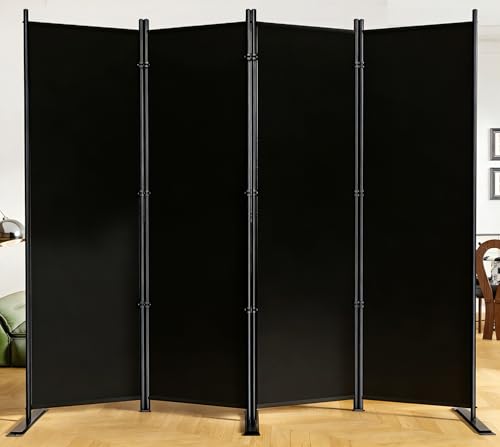
Best for: a quick four-panel screen with no fuss Skip it if: you want published weight and warranty details
The SUNALLY covers 88 in across four panels at 71.3 in tall. SUNALLY describes flexible multi-buckle hinges that adjust to any angle, which is what makes this the lowest-fuss setup among the freestanding picks. Fold, stand, angle, done.
The frame is stated as reinforced steel with a powder-coated finish, called scratch- and rust-resistant, and the screen as high-density polyester with a PA coating for non-see-through privacy. Those are the maker's claims. The listing says all hardware and instructions are included for a quick setup.
Two figures are missing that other picks publish: weight and warranty. That's the honest gap here. You can't judge how steady it stands or how it's backed without those numbers, so I've ranked it below the picks that state them. It sits at the second-lowest price in this set, so the trade is fewer published details for a lower position. If you want a straightforward four-panel screen and don't need the spec sheet spelled out, it does the job. If weight and warranty drive your choice, the MAYOLIAH answers both.
Pros:
- Adjustable-angle multi-buckle hinges per maker
- Steel frame with powder coating claim
- 88 in width across four panels
- Second-lowest price in the set
- Hardware and instructions included
Cons:
- No published weight
- No published warranty
- Slowest seller of the six
- Narrower reach than the Rantila
5. Grezone Room Divider-Folding Privacy Screens — Best for pros
The Grezone covers the longest run in this set at 200 in wide, built for classrooms, studios and offices.

Best for: classrooms, studios and offices needing long coverage Skip it if: only one seller stocking it worries you
The Grezone's headline is reach: 200 in wide at 71 in tall. That's the longest single span here, wider even than the Rantila, and it's aimed squarely at institutional spaces. Grezone lists it for college dorms, small offices, churches, studios and classrooms, and calls out use as a background for video calls.
At 20.9 lb it's substantial, which suits a screen meant to stand in one place through a school day. The listing says assembly needs only a Phillips screwdriver and can be done solo. That's a fair claim for a screen this size.
The real caveat is availability: only one seller lists it. That thins your options if something goes wrong, and no warranty is published either. Against the Rantila, the Grezone reaches further but weighs more and covers a working room rather than a home nook. Against the MAYOLIAH, it's longer but lacks the stated warranty. For pros who need to section off a big space and leave it, the 200 in span is the reason to pick it. For a bedroom, it's more divider than you need.
Pros:
- Longest span in the set at 200 in
- Solo assembly with one screwdriver per maker
- Steady 20.9 lb for fixed placement
- Built for offices and classrooms
- Freestanding, no wall needed
Cons:
- Only one seller lists it
- No published warranty
- Heavier than the Rantila
- Oversized for most bedrooms
6. SUNALLY Room Divider for Separation 28-114in — Best budget pick
This SUNALLY is the odd one out: a no-drill tension curtain rod, not a panel screen, and the lowest-priced pick here.

Best for: renters who can't drill and want an adjustable curtain rod Skip it if: you expect a solid panel screen, not a rod
Read the listing before you buy: this is a curtain rod, and SUNALLY states the curtains are not included. It's the lowest-priced pick in the set and the one buyers here choose most often, which makes sense for renters. SUNALLY describes a no-drill rod that leaves no holes in walls or ceilings, adjustable in height from 4 ft to 10 ft and in width from 28 in to 114 in.
The rod is stated as solid stainless steel, rust-proof, and the listing says it installs and removes in minutes with no tools. At 11.7 lb, it packs down small between moves.
Its whole trade against the panel screens is what it is: a rod that holds a curtain you supply, not a standing screen. That means an extra buy and a soft, movable divider rather than a rigid one. But for a rental where drilling is off the table, nothing else here works the same way. More sellers stock it than any other pick. If you want a real panel, look to the Rantila; if you can't put a hole in the wall, this is your answer.
Pros:
- Lowest price in the set
- No-drill install for rentals per maker
- Wide adjustable span, 28 to 114 in
- Stainless steel rod claim
- More sellers stock it than the rest
Cons:
- Curtains not included
- A rod, not a panel screen
- No published warranty
- Needs a separate curtain purchase
Does cheap mean flimsy here?
Cheap here does not automatically mean flimsy, but the listings force you to read the frame claim carefully. Frame material is where the picks separate, and every maker states it differently.
- Steel or iron frames: the MAYOLIAH (iron, powder-coated) and the SUNALLY 4-panel (steel, powder-coated) claim rust and scratch resistance. Heavier, sturdier.
- Wood frame: the FDW is described as environmentally friendly wood. Lighter and warmer-looking, at 11 lb.
- Fabric on frame: the Rantila pairs a coated fabric panel with a frame, keeping weight to 16 lb across 142 in.
- Steel rod: the SUNALLY 28–114in is a stainless rod, not a screen at all.
Weight is the tell. The 22.6 lb MAYOLIAH and 20.9 lb Grezone stand firmest because there's more frame in them. The 11 lb FDW is the easiest to knock, which is the cost of carrying it easily. None of these claims are things I can verify beyond the listing, so treat frame material as a maker's statement and match it to how rough your use will be.
How wide a space can each one cover?
Width is the figure that should drive your shortlist, so here's every pick sorted by reach. This is the comparison that matters most among the best cheap room dividers.
- Grezone, 200 in — longest run, built for large rooms.
- Rantila, 142 in — widest freestanding home screen.
- MAYOLIAH, 120 in — six panels across, bends to a corner.
- SUNALLY rod, 28–114 in — adjustable, for a curtain.
- SUNALLY 4-panel, 88 in — a compact four-panel screen.
- FDW, 17 in per fold — narrow segments, best for a doorway gap.
Measure your gap first, then read this list. A screen that falls short leaves a sightline open, which defeats the point. If you're covering a wide open-plan split, the Grezone and Rantila are your only real fits. For a corner nook, the MAYOLIAH's bend beats raw width. For a doorway, the FDW is plenty. And if you can't drill, the SUNALLY rod stretches to 114 in and takes a curtain you choose.
When a different pick wins
The Rantila leads, but three clear conditions hand the win to another pick.
- If you rent and can't drill, the SUNALLY 28–114in rod wins. It leaves no holes and adjusts from 28 in to 114 in.
- If you need a permanent corner with a warranty, the MAYOLIAH wins on its 1-year cover and iron frame.
- If you're outfitting a classroom or studio, the Grezone's 200 in span wins on reach alone.
Each flip turns on one checkable fact: your ability to drill, your need for a warranty, or the width you have to cover. Match the fact to the pick and the choice makes itself.
The verdict
If you're splitting a home space and want the most reach for the least weight, the Rantila 2-panel wins. Its 142 in span at 16 lb covers an open-plan gap in one stretch, and no other freestanding home screen here matches that ratio. That's the default pick for most buyers.
If you rent and can't put a hole in the wall, the SUNALLY 28–114in rod is the better buy. It installs with no tools, adjusts from 28 in to 114 in, and takes a curtain you choose. The cutoff is simple: drilling allowed, go Rantila; drilling forbidden, go rod.
The MAYOLIAH's exact advantage over the winner is its published 1-year warranty, the only one in this set, plus a six-panel bend that holds a corner without a wall. If a stated warranty and a permanent L-shape matter more than reach and light weight, pay the premium for it. And if you're sectioning a classroom or office, the Grezone's 200 in span outreaches everything, at the cost of thin availability and no published warranty. Pick on the width you need and the wall you're allowed to touch.
FAQ
Are cheap room dividers worth buying at all?
Cheap room dividers are worth buying when you match the pick to your gap and your walls. The Rantila covers 142 in on 16 lb, and the SUNALLY rod adjusts from 28 in to 114 in with no drilling. The risk is buying too narrow a screen, which leaves a sightline open. Measure first, then choose, and a low-cost divider does real work.
Is the Rantila worth it over the lighter FDW?
Is the Rantila worth choosing over the FDW? For coverage, yes. The Rantila spans 142 in against the FDW's 17 in folds, so it splits a whole room where the FDW handles a doorway. The FDW wins only on weight, 11 lb to the Rantila's 16 lb, which matters if you move the screen constantly. Pick on how wide your gap is.
How wide a room can these dividers cover?
How wide a space these dividers cover ranges widely. The Grezone reaches 200 in, the Rantila 142 in, the MAYOLIAH 120 in, and the SUNALLY 4-panel 88 in. The SUNALLY rod adjusts from 28 in to 114 in. Measure your opening before ordering, because a screen that falls short leaves the very sightline you meant to block.
MAYOLIAH or Grezone for a large space?
MAYOLIAH or Grezone depends on shape. The Grezone reaches 200 in, so it wins for one long straight run in a classroom or studio. The MAYOLIAH spans 120 in but folds into a stable corner and carries a 1-year warranty, the only one here. Choose the Grezone for length, the MAYOLIAH for a backed, angled corner.
What's the biggest mistake buying a room divider?
The biggest mistake buying a room divider is judging by panel count instead of width. Four narrow panels can cover less than two wide ones: the FDW folds in 17 in segments while the Rantila stretches 142 in. Also read the listing closely, since the SUNALLY 28–114in is a curtain rod with no curtain included, not a solid screen.
Measure your gap, decide whether you're allowed to drill, and the shortlist writes itself. For most home splits the Rantila is the safe default, because 142 in of reach at 16 lb solves the widest problem with the least lifting. Renters skip straight to the SUNALLY rod, and anyone outfitting a working room reaches for the Grezone's 200 in span. Check the width figure against your opening one more time, then open the listing for the pick that fits.