Best Room Dividers for a Studio Apartment Dweller

Six freestanding, tension-mounted, and shelved dividers compared for studios, with a bamboo six-panel screen leading and a curtain-rail runner-up for renters.

By Jadiel FranklinUpdated 14 min read
On this page
- Best room dividers for studio apartment life at a glance
- How I screened this shortlist
- 1. Furnnylane 6 Panel Bamboo Room Divider — Best overall
- 2. hoeflife Room Divider Curtains Flexible Ceiling Tracks Set — Best for families
- 3. AKTOP 3 Panel Room Divider 6FT — Best for beginners
- 4. AJAZZ Room Divider Curtain — Best for heavy use
- 5. Goovilla Room Divider for Room Separation — Best budget pick
- 6. Tribesigns Room Divider with Shelves — Best premium
- Freestanding, tension-mounted, or shelved: which fits a studio?
- What to measure before you buy
- Renter rules: what your lease actually cares about
- Head-to-head: Furnnylane vs. AJAZZ for a one-room layout
- The verdict
- FAQ
The best room dividers for studio apartment layouts is the Furnnylane 6 Panel Bamboo Room Divider, an unfolding 67" H x 92.1" W screen that weighs under 21 lb and needs no assembly. If your studio has a shared sleep zone that you want to fully curtain off, the hoeflife Flexible Ceiling Tracks Set with a 100"W x 84"L blackout drape is the better buy. Both create real separation. Only one asks you to touch the ceiling.
Best room dividers for studio apartment life at a glance
| Pick | Coverage (W × H) | Weight | Price |
|---|---|---|---|
Best overall Furnnylane 6 Panel Bamboo Room Divider |
92.1 × 67 in | Under 21 lb (claim) | Check Price |
Best for families hoeflife Ceiling Tracks Set |
100 × 84 in | Not listed | Check Price |
Best for beginners AKTOP 3 Panel Room Divider 6FT |
103 × 70.2 in | 12.2 lb | Check Price |
Best for heavy use AJAZZ Room Divider Curtain |
100 × 84 in | 11 lb | Check Price |
Best budget pick Goovilla Tension Divider |
28–70 × 48–120 in | 7.61 lb | Check Price |
Best premium Tribesigns Room Divider with Shelves |
47.2 × 70.9 in | 98.1 lb | Check Price |



How I screened this shortlist
I started with the room dividers category and cut hard against studio realities. Anything requiring wall anchors was out. Anything under five feet tall was out, because a divider that only screens your knees is not a divider. The six survivors split cleanly into three formats: folding panel screens, tension-mounted curtain systems, and one heavy shelving unit that doubles as a partition.
The picks span a wide spread. The lightest weighs 7.61 lb. The heaviest weighs 98.1 lb. The narrowest coverage is 47.2 in wide; the widest is 103 in. Two are all fabric. Two are all wood or wood-and-metal. Two rely on curtain drape.
Studios reward flexibility, so I weighted repositioning ability heavily. Four of the six are under 22 lb and one person can move them alone. Only Tribesigns cannot: at 98.1 lb it stays where you put it, which is the point of a premium pick.
1. Furnnylane 6 Panel Bamboo Room Divider — Best overall
A 92-inch-wide bamboo screen that unfolds in one motion and weighs less than a bag of dog food.
Best for: renters who want a full 92-inch wall of privacy in seconds Skip it if: you need to block sound, not just sightlines
Six panels, each 15.35 in wide, unfold to a 66.9 x 92.1 in wall. That is wider than the entry-tier AKTOP fabric screen only in height terms; AKTOP is actually wider at 103 in. What makes the Furnnylane the anchor of the six is the format: solid bamboo panels on a pinewood frame, hinged both ways, so it stands in an S-curve without leaning on anything. The listing puts weight under 21 lb, which is why it earns "best overall" for a small home where furniture gets moved every month.
Furnnylane says the frame is hand-sanded solid pinewood with reinforced metal hinges and non-slip base pads. The company also says there are no chemical paints, synthetic glues or toxic hardware, which matters if the divider stands in a sleeping alcove. It is the most expensive folding screen in the set, and it is the only bamboo one, but it needs zero tools and zero ceiling contact.
Pros:
- Full 92.1 in open width in one motion
- Weighs under 21 lb, one-hand repositioning
- No assembly and no wall or ceiling contact
- Six-panel S-fold stands without leaning
- Bamboo and pinewood with no listed synthetic glues
Cons:
- Screens sightlines only, not sound
- The most expensive folding screen in this set
- Panels are opaque, so light does not pass through
2. hoeflife Room Divider Curtains Flexible Ceiling Tracks Set — Best for families
A bendable ceiling track and 100 × 84 in blackout drape that curtains off a sleep zone properly.

Best for: parents zoning a sleep corner from a living area with a ceiling track Skip it if: your ceiling is textured, vaulted, or you cannot drill
This is the only pick that actually reaches the ceiling on a curved path. The set combines a flexible bending track with a 100"W x 84"L blackout curtain, so you can trace an L-shape around a crib, a bed, or a desk corner. hoeflife says the track suits DIY installs and provides smooth sliding. That flexibility is what a folding screen cannot match: a screen goes straight, a bendable rail turns a corner.
It sells faster than the rest of this set, which suggests the format resonates with buyers. The trade-off is real. You must drill the ceiling, and a rented studio may not allow that. If yours does, this is the pick that makes a studio feel like two rooms. Wash cold, iron low, and expect an afternoon of layout planning before you commit.
Pros:
- Bendable track goes around corners, unlike any panel
- 84 in drop reaches most standard ceilings
- Blackout fabric doubles as a light barrier
- Curtain included, unlike the tension-rod pick
- Sells faster than the rest of this set
Cons:
- Requires drilling into the ceiling
- Not suitable for angled or vaulted ceilings
- No stated weight or track length in the listing
3. AKTOP 3 Panel Room Divider 6FT — Best for beginners
The widest folding screen here at 103 in, on a powder-coated metal frame that weighs just 12.2 lb.
Best for: first-time buyers wanting the widest coverage at a moderate weight Skip it if: you dislike any assembly out of the box
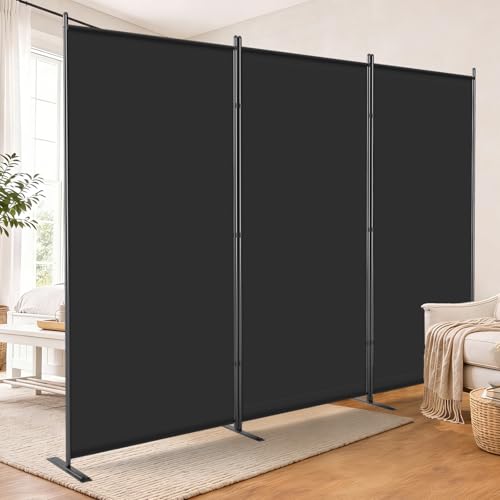
Three panels, 103 in of open width, 70.2 in tall, 12.2 lb total. AKTOP is the widest folding screen in the set and the second-lightest overall, which is a useful combination for a studio: a taller, wider footprint that still lifts one-handed. AKTOP says the powder-coated metal frame rests on 12.5-inch widened bases, which is what keeps a tall fabric panel from tipping when a cat brushes past.
The fabric is a 160g non-see-through polyester the brand says blocks direct visibility. It folds down to 34 in wide for storage, so it slides behind a sofa when you want the studio open again. Assembly is required, unlike Furnnylane, and the listing tells you to check parts before starting. That is the trade-off for the extra height and width against the bamboo pick.
Pros:
- 103 in widest open coverage in the set
- 12.5 in widened bases for stability
- Folds to 34 in wide for storage
- Only 12.2 lb, second-lightest here
- No ceiling or wall contact needed
Cons:
- Ships unassembled with a step-by-step manual
- Fabric screens sightlines only, not sound
- No published weight capacity or warranty
4. AJAZZ Room Divider Curtain — Best for heavy use
A blackout curtain and no-drill tension rod that adjusts from 43 to 120 in tall and 35 to 100 in wide.

Best for: night-shift workers separating a sleep zone from a workspace Skip it if: your ceiling exceeds 120 inches or is angled
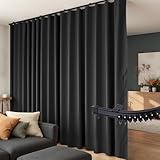
AJAZZ pairs a 100"W x 84"L blackout curtain with a tension rod that extends from 43 to 120 in in height and 35 to 100 in in width. That range is what makes it the only pick in this set that adapts to almost any studio ceiling without drilling. The full assembly weighs 11 lb.
AJAZZ says the fabric is 100% blackout and includes a built-in sound-dampening triple weave that absorbs echo in a shared workspace. Attribute that as the manufacturer's claim, not a measured decibel figure: there is no dB number on the listing. What you can rely on is the mechanical setup. Tension between the floor and the ceiling holds the rod, grommets slide the drape open and closed, and nothing marks the wall. For a renter running a sleep and work zone in the same room, this is the format that flexes both ways daily.
Pros:
- Height adjusts from 43 to 120 in, tallest range here
- Curtain and rod both included, no extras needed
- 100% blackout claim for dark sleep zones
- No drilling, so deposits are safe
- 11 lb total, straightforward one-person setup
Cons:
- Sound-dampening is a manufacturer claim without a dB figure
- Angled or vaulted ceilings will not hold tension
- Curtain hand-wash only, no machine cycle
5. Goovilla Room Divider for Room Separation — Best budget pick
A tension-mounted rod that spans 48 to 120 in tall and 28 to 70 in wide, at just 7.61 lb.

Best for: renters on hard floors who want a floor-to-ceiling look without drilling Skip it if: your ceiling is angled, vaulted, or you want the curtain included
Goovilla is the cheapest of the six and the lightest at 7.61 lb. It is also the only pick that ships as a bare tension rod. Goovilla is direct in the listing: curtains not included. That is why it earns a budget spot rather than a category anchor. You bring your own drape, sheet, or hanging fabric, thread it on, and press the rod against the ceiling.
Goovilla says the rod adjusts from 4 to 10 feet tall and 28 to 70 in wide with tension only, and specifically says it is not for angled or vaulted ceilings. The listing lists tile, wood, marble, concrete, plaster, popcorn and textured ceilings as compatible. For a studio with an 8-foot ceiling and a rented deposit at stake, the appeal is obvious: it is the second-cheapest starting point in the entire set once you add a curtain, and one of two picks with more than one seller listing it.
Pros:
- Cheapest pick in the set
- Lightest at 7.61 lb
- 4 to 10 ft height range, 28 to 70 in width
- No-drill tension mount, no ceiling damage
- Works on tile, wood, marble, and concrete
Cons:
- Curtains not included, sold separately
- Not compatible with angled or vaulted ceilings
- No included curtain rings or hooks in the listing
6. Tribesigns Room Divider with Shelves — Best premium
A 70.9 × 47.2 in shelving unit at 98.1 lb that divides, stores, and hangs coats in one piece.

Best for: owners who want the divider to double as a bookshelf and coat rack Skip it if: you move often or need to fold it away
Tribesigns is the outlier and the point of including it is honesty about trade-offs. At 98.1 lb, it is roughly five times the weight of the Furnnylane and thirteen times the weight of the Goovilla. It does not fold. It does not travel. Once you assemble it, it stays.
What you get is a piece of furniture that earns floor space three ways. Tribesigns says the frame combines E1-grade MDF with thickened metal tubes on a 7.3-inch thick base with anti-tip hardware. Open shelves hold books, plants and framed photos; hanging hooks take coats, bags, and hats. The 47.2 in width is the narrowest coverage here, which is deliberate: an open divider that lets air and light through is the point. It is the most expensive pick in the set, and it costs the most because it replaces a bookshelf and a coat rack too.
Pros:
- Open shelves and hanging hooks combined
- Anti-tip hardware on a 7.3 in thick base
- Air and light circulate through the openings
- E1-grade MDF and metal tube construction
- Doubles as a bookshelf, cutting a furniture purchase
Cons:
- 98.1 lb makes repositioning a two-person job
- Narrowest open width in the set at 47.2 in
- Most expensive pick in the set
- Assembly required, unlike Furnnylane
Freestanding, tension-mounted, or shelved: which fits a studio?
Three formats cover this shortlist. Each solves a different problem in a small home.
- Freestanding folding screens (Furnnylane, AKTOP) unfold from flat and stand on their own bases. They screen sightlines instantly, weigh under 21 lb, and pack away when guests arrive. They do not touch the ceiling and they do not stop noise.
- Tension-mounted curtain systems (AJAZZ, Goovilla) press a rod between the floor and the ceiling and hang a drape from it. They reach the ceiling, blocking light and giving a real "second room" feel. They fail on angled ceilings and they mark textured ones over time.
- Shelved dividers (Tribesigns) work as furniture that happens to partition a space. They anchor a layout and hold your stuff. They cost more, weigh more, and stop being flexible the day you build them.
The right choice comes down to whether you move furniture often, whether you can drill, and whether the divider needs to hide clutter as well as sightlines.
What to measure before you buy
Studio floor plans lie. Before you order anything, measure four things.
- Ceiling height at the divider line. Tension systems fail if the ceiling is more than 120 in above the floor or if it slopes across your intended run.
- Ceiling texture. Popcorn and heavily textured ceilings can hold a tension rod but will not always accept a screw-in track cleanly. hoeflife's flexible track wants a firm anchor.
- Open floor width at the divider line. AKTOP opens to 103 in, Furnnylane to 92.1 in. If your available run is only 60 in, both screens overhang.
- Weight budget for moving day. Tribesigns at 98.1 lb needs two people and a plan. Goovilla at 7.61 lb slots in a car boot.
Write these four numbers down before you compare picks. Half the mismatch complaints in this category come from skipping one of them.
Renter rules: what your lease actually cares about
Studios and one-bedrooms are usually rentals, so the divider you pick has to survive move-out inspection. Two categories of pick sit on the safe side of that line. Two need permission.
- No-permission picks: Furnnylane, AKTOP, Goovilla, AJAZZ, Tribesigns. None of these need holes in the wall or ceiling. Tension rods press but leave no lasting mark on hard surfaces.
- Permission-needed pick: hoeflife. The ceiling track uses fixings. If you rent, ask before you buy.
Deposit protection is the reason five of six picks avoid drilling. It is also why the freestanding and tension formats dominate small-home dividers as a category. Keep receipts, keep original hardware, and photograph the ceiling before install if you go the drilled route. A ten-minute set of photos on move-in day is worth more than any product warranty.
Head-to-head: Furnnylane vs. AJAZZ for a one-room layout
The two picks a studio dweller most often chooses between are the Furnnylane bamboo screen and the AJAZZ tension curtain. They solve the same problem from opposite ends.
Furnnylane gives you a solid 92.1 in wall of bamboo that stands on its own bases. Under 21 lb. Zero setup. Opaque. It stops sightlines cold across a 6-foot run and packs flat when a friend crashes on the sofa.
AJAZZ gives you a 100 × 84 in blackout curtain on a tension rod that adjusts from 43 to 120 in tall. Eleven lb. Blocks light, screens sightlines, and AJAZZ says the triple weave dampens echo. Fabric flexes when you brush past. Rod height flexes to almost any ceiling.
The cutoff: if you want the divider to be a physical object you can lean against and walk around, Furnnylane wins. If you want the divider to reach the ceiling and darken a sleep zone, AJAZZ wins. Only one can hit the ceiling. Only one is a solid wall. The rest is preference.
The verdict
Two buyers, two winners. If your studio has standard ceilings and you value a divider you can move on impulse, the Furnnylane 6 Panel Bamboo Room Divider is the right default. Under 21 lb, 92.1 in wide when open, no assembly, no ceiling contact. It sets up in a minute and repositions in another.
If your studio needs a real sleep or work zone with light control and your ceiling is between 43 and 120 in high, the AJAZZ Room Divider Curtain is the better buy. The blackout drape and tension rod reach the ceiling without drilling, and AJAZZ says the triple weave dampens echo in a shared space.
The cutoff between them is simple: does the divider need to hit the ceiling? Under that threshold, Furnnylane wins on flexibility and speed. Over it, AJAZZ wins on coverage and light. Buyers who want the divider to hold books and coats too should step up to Tribesigns; buyers on the tightest budget should pair Goovilla with a curtain they already own. All five picks solve a real problem. Pick the one whose problem is yours.
FAQ
Are room dividers actually worth it in a studio apartment?
Room dividers are worth it in a studio when the alternative is one open space with no visual separation. A screen or curtain lets you hide an unmade bed from the sofa, screen a workspace from a guest, or darken a sleep corner. The under-21-lb picks here (Furnnylane, AKTOP, AJAZZ, Goovilla) fold or pack away when you want the studio open again, so you are not locked into the layout.
Which room divider works for renters who can't drill?
Renters who can't drill should choose a freestanding screen or a tension-rod curtain. Furnnylane, AKTOP, and Tribesigns stand on their own bases with no ceiling contact. AJAZZ and Goovilla use tension between floor and ceiling with no fasteners. Only the hoeflife track needs ceiling fixings. Five of the six picks here leave zero permanent marks, which is why the category leans no-drill.
How tall should a room divider be for a studio apartment?
For a studio apartment, aim for a divider that reaches at least eye level when you're standing: roughly 65 in and up. Furnnylane hits 67 in, AKTOP 70.2 in, and Tribesigns 70.9 in. The AJAZZ and hoeflife curtains reach 84 in, which is closer to a full wall effect. Under 60 in and the divider screens your knees but not your laptop.
Furnnylane bamboo screen vs. Tribesigns shelved divider: which for a small studio?
Furnnylane bamboo screen wins for most studios because it folds, weighs under 21 lb, and covers 92.1 in of open width. Tribesigns is a 98.1 lb piece of furniture that also stores books and coats on shelves and hooks. Pick Tribesigns only if you plan to leave the divider in place for years and want it to replace a bookcase. Pick Furnnylane if you rearrange often.
What's the biggest mistake first-time buyers make with a room divider?
The biggest mistake first-time buyers make is buying on looks and skipping the measurement. Tension rods will not hold on angled or vaulted ceilings. Folding screens with narrow bases tip on plush carpet. Shelving dividers weigh close to 100 lb once assembled. Measure ceiling height, ceiling texture, floor type, and open run width before you order, and the divider will fit the room instead of fighting it.
Start with the divider that matches your move-out plan first, your ceiling second, and your budget third. That order matters because a beautifully priced screen that damages a ceiling costs more than the most expensive pick here. The Furnnylane wins the default vote because it makes zero assumptions about your building: no drilling, no tension, no ceiling angle math, no assembly. Unfold it, set it, forget it. When your lease ends, fold it flat and it goes in the car with the rest of your things. That is the trait a studio dweller values above every specification, and it is the reason a folding bamboo screen still beats every fancier format in this category.